Video seriesAll four parts out now
Moving to Self-Clearing
The work your clearing firm used to do
When a broker-dealer starts clearing its own trades, the regulatory work its clearing firm did in the background moves in-house: the Letters of Free Funds, the prime brokerage forms, the quarterly count, and the records behind all of them. This series takes that work one part at a time. Each part runs about six minutes, with the narration captioned on screen.

Part 1 of 46:30Released
Conversion Day
Moving to Self-Clearing, Part 1: Conversion Day. 6:30, captioned.
A broker-dealer that clears through another firm gets a long list of regulatory work done for it, mostly out of sight. On conversion day, the list becomes its own. Part 1 follows the six stops most conversions pass through, the small daily jobs firms tend to find late, and the reason your vendor reviews should start while your approvals are still pending.
What it covers
- Why firms make the move, and what it takes
- The six stops, from the business case to your first quarter-end and your first annual audit
- The regulatory work a clearing firm does for you, line by line
- The spreadsheet and mail merge that stand in for a process, and how they become the process
- Starting vendor reviews early, and choosing between a nightly file and an API
- A three-point checklist
Transcript 881 words
Picture a broker-dealer that's just been approved to clear its own trades. The applications to DTC and NSCC are in. The project plan has workstreams for net capital, the reserve computation, and the stock record. Then someone in compliance asks a simple question. When a client's custodian is another broker-dealer... who sends the Letter of Free Funds? Until now, the answer was the clearing firm. After conversion day, it's you.
This is Moving to Self-Clearing, a four-part series on the regulatory work your clearing firm used to do. Part one: what changes on conversion day.
Firms make the move for good reasons. More control over operations and the customer experience: statements, tax documents, proxy voting. Lower clearing fees. And revenue the clearing firm used to keep. It isn't quick, and it isn't cheap. When Robinhood built its own clearing system, it took two years and nearly a hundred additional people. Most of the cost is technology and experienced operations staff.
Every conversion is different, and no rule sets the timeline. But most follow the same line, with six stops.
Stop one: decide, and build the business case.
Stop two: approvals and capital. Carrying customer accounts raises your minimum net capital, and FINRA treats that as a material change in your business. So expect to file a Continuing Membership Application. The SEC's floor for a carrying firm is two hundred and fifty thousand dollars. In practice, the clearing agencies set the number that matters, through risk-based requirements and clearing fund deposits that move with your activity. This is also when customer protection becomes yours. You'll compute the customer reserve, fund a special reserve bank account, and keep customer securities in your possession or control. Larger carrying firms now run that computation every day.
Stop three: clearing memberships. DTC for custody and settlement, NSCC for equity clearing, and OCC and FICC if your business needs them.
Stop four: build the operation. Systems, staff, procedures. We'll come back to this one, because it's where the surprises are.
Stop five: conversion day. Accounts move from your clearing firm's books to yours, and you settle under your own DTC participant number. Customers notice this day, so plan the communication: statements, tax forms, and anything that might be delayed.
Stop six: the first quarter and the first year. Your first quarter-end brings your first securities count. And your first annual audit brings a compliance report, in place of the simpler exemption report you filed as an introducing firm.
Now, back to stop four, and the part that's easy to miss. When you clear through someone else, your clearing firm quietly does a long list of regulatory work for you. Letters of Free Funds on your DVP trades. Prime brokerage paperwork. The quarterly securities count. Closing out fails. The customer reserve. Confirmations and statements. Anti-money-laundering monitoring. And the records for all of it. On conversion day, every line on this list becomes yours. Some of these are big, visible projects, and they get planned early. Others are small, repetitive jobs that run every day in the background. Those are the ones firms tend to find late. To be clear about where we fit: Loffa doesn't compute your reserve, file your FOCUS reports, or send your customer statements. We handle the Letters of Free Funds, sent and received, the prime brokerage forms, and the quarterly count. And we keep a copy of everything we process.
So what happens when one of those small jobs is found late? Usually, someone builds a stopgap. A spreadsheet of DVP trades, a mail merge, and a shared inbox for the replies. The letters go out on time, and it looks automated. Then the questions start. Which custodian takes letters at which desk? Who follows up when nobody answers? Where's the record of each letter, and each reply? And when an examiner asks for every letter on one account from last March, how long will it take to find them? A stopgap that starts on conversion day has a way of becoming the process.
The fix is mostly about timing. For most firms, the slowest part of adding a vendor isn't the technology. It's the vendor review: security documentation, SOC reports, business continuity planning. So start those reviews while your membership application and clearing agency approvals are still pending, not after conversion. And decide early how your data will reach a vendor. A nightly file over secure FTP gives your security team a narrow, known set of data to approve. A live API brings more systems into scope, and a longer review. Neither is wrong. They just run on different timelines. Loffa is SOC 1 and SOC 2 Type II audited. And in 2003, the SEC staff issued a no-action letter on how our Letter of Free Funds network works.
Three things to take from this episode. One: read your carrying agreement, and list every function your clearing firm performs for you. Two: start vendor reviews while your approvals are pending. Three: choose between a batch file and an API before those reviews begin.
Next time: the Letter of Free Funds. Who sends it now, which trades need one, and what to do with the ones that start arriving at your door. To walk your compliance and operations teams through the move, email info@loffacorp.com.
Part 2 of 46:22Released
The Letter of Free Funds
Moving to Self-Clearing, Part 2: The Letter of Free Funds. 6:22, captioned.
Once you clear your own trades, the Letters of Free Funds your clearing firm sent are yours to send. Part 2 covers the Regulation T rule behind the letter, who sends it now, the four checks that decide which trades need one, and where each letter has to go. Then it turns to the letters that start arriving at your door once you hold assets for customers who trade through other brokers.
What it covers
- Regulation T’s 90-day freeze, and the written-statement exception the letter relies on
- Who sends the letter before conversion, after it, and when you clear for another firm
- Four checks for which trades need a letter, municipal bonds included
- Custodians that take letters at several desks, by network, email, or fax
- The receive side, and how long both halves are kept under Rule 17a-4
- How FVD-S and FVD-R handle the send and receive sides
- A three-point checklist
Transcript 890 words
Your firm started clearing its own trades this week. Tomorrow, an institutional client's purchase settles, delivery versus payment. The client's cash sits at another broker-dealer. Before that trade settles, someone has to ask that broker-dealer for a Letter of Free Funds: a written statement that the money is there. So who sends it? The SEC staff put it plainly in 2003. When the executing broker is not self-clearing, the broker-dealer that clears and settles the trade would make the request. You clear and settle now. So it's you.
This is Moving to Self-Clearing, a four-part series on the regulatory work your clearing firm used to do. Part two: the Letter of Free Funds.
Start with why the letter exists. Under Regulation T, if a security is delivered to another broker or dealer before the customer has paid for it in full, the customer's cash account is frozen for ninety days. There's one exception that matters here. No freeze applies if the security went to another broker or dealer, for deposit in a cash account that already holds enough money to pay for it. And you may rely on that firm's written statement, accepted in good faith. That written statement is the Letter of Free Funds. And under T plus one, the trade settles the next business day, so the answer has to come back fast.
Before conversion, you executed and your clearing firm cleared, so your clearing firm sent the letters. After conversion, you clear and settle, so you send them. And if you start clearing for other firms, their letters are yours too.
Not every trade needs a letter. Picture your trade file running through four gates.
Gate one: is the custodian a broker or dealer? The freeze only applies to delivery to another broker or dealer, so banks and trust companies are out. But a bank's broker-dealer affiliate is a broker-dealer. Check the entity, not the brand name.
Gate two: is the security nonexempted? Treasuries are exempted securities, so they're out. Equities and corporate bonds are in.
Gate three is a policy call: municipal bonds. They're exempted securities too, but some firms verify them anyway. A general obligation bond rests on the issuer's power to tax. A revenue bond depends on what one project earns, like a stadium bond in a season with no ticket sales. Whatever you decide, write it into your procedures.
Gate four: is the account documented prime brokerage? Prime brokerage runs on its own paperwork, so those trades are out. That's Part three. What comes out the other side is your letter queue.
Then each letter has to reach the right place. Some large custodians take letters at several different desks, depending on the account number. Some take them over a network, others by email or fax. Send one to the wrong desk, and the clock keeps running.
There's a second half. Once you hold assets for customers who trade through other brokers, their letters start arriving at your door. Each one asks you to confirm the money is there, and each one is a small deadline. Both halves are records. As communications, they're kept at least three years, the first two in an easily accessible place.
So what does this look like without the rails? The mail merge from Part one sends the letters on time. Then the replies come back. One went to the wrong desk, and nobody answered. One is a typed paragraph that nobody can classify. Was that a yes? Inbound letters pile up in a shared mailbox, each one waiting for someone to find the account. And when an examiner asks for every letter on one account from last March, the inbox is the record.
This is the work FVD was built for. Freefunds Verified Direct has two halves. FVD-S sends. FVD-R receives.
On the send side, a nightly file of qualifying trades arrives over secure FTP. Your filter, municipal policy included, picks the trades that need a letter. Each one becomes a standardized Letter of Free Funds, routed to the right desk from a custodian directory our operations team keeps, and delivered over the FVD network, by email or by fax. Replies come back as standardized statuses, not typed paragraphs: new, returned, review needed, trade unknown, invalid account number. Supervisors see them on dashboards and open-item reports, and the system follows up when replies slow down.
On the receive side, FVD-R takes inbound letters on one channel. AI indexes the ones that arrive by email or fax, so your desk works a queue, not an inbox. And FVD works with our prime brokerage product. Once the prime brokerage forms are on file for an account, letters for it stop, and incoming ones are declined with a reason. FVD keeps every letter, reply and status change for eight years, three of them in the application. Loffa retains the records it processes. Your firm's own record-keeping obligations stay with your firm.
Three things to take from this episode. One: write down your letter filter, including your municipal bond policy. Two: confirm where each custodian wants its letters. Three: set up the receive side before you hold assets for customers who trade away.
Next time: the letter's big brother. Prime brokerage forms, and what happens when one is missing. To walk your compliance and operations teams through the move, email info@loffacorp.com.
Part 3 of 45:49Released
Prime Brokerage Forms
Moving to Self-Clearing, Part 3: Prime Brokerage Forms. 5:49, captioned.
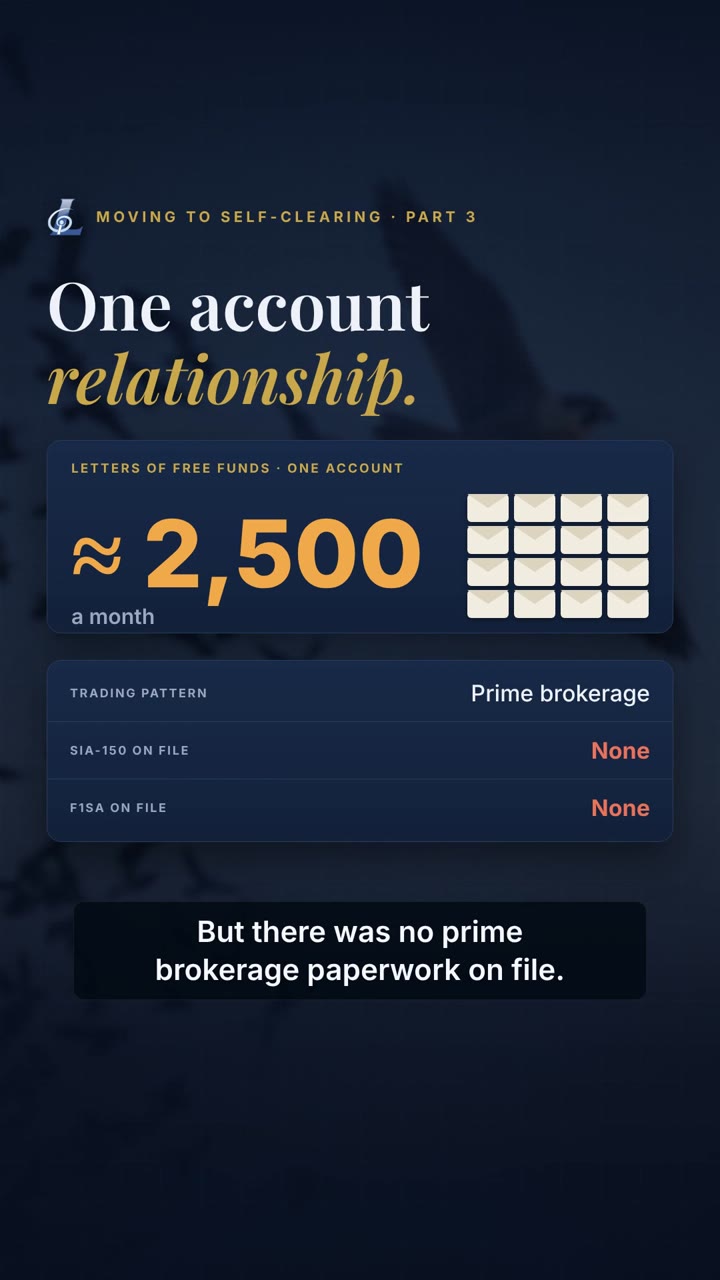
Prime brokerage is the Letter of Free Funds’ big brother. When an account meets the conditions in the SEC staff’s 1994 letter, its trades don’t need a Letter of Free Funds. Without the paperwork, every trade does. Part 3 opens on one account that was on track for about 2,500 letters a month, then covers the forms that document the relationship, who sends and receives them once you clear, and what an examiner asks to see.
What it covers
- The SEC staff’s 1994 prime brokerage letter, and the footnote that takes away the Letter of Free Funds
- The SIA-150, the F1SA, and the SIA-151, and what each one documents
- Who sends and receives the forms once you clear, and the net capital floors the letter sets
- What a missing F1SA costs the executing broker beyond the letters: confirmations and disaffirmed trades
- What an examiner asks to see, including the confirmation path for omnibus accounts
- How PBIN keeps the forms and stops FVD’s letters for a documented account
- A three-point checklist
Transcript 792 words
An executing broker we work with was sending Letters of Free Funds to another firm at more than a hundred a day. All on one account relationship. At that pace, one account was on track for about two thousand five hundred letters a month. The trading looked like prime brokerage. But there was no prime brokerage paperwork on file. And after a week of follow-ups, nobody could say whether there ever would be.
This is Moving to Self-Clearing, a four-part series on the regulatory work your clearing firm used to do. Part three: prime brokerage forms.
In Part two, the Letter of Free Funds kept a customer's cash account out of a ninety-day freeze. Prime brokerage is the letter's big brother. Under the SEC staff's 1994 prime brokerage letter, when a long list of conditions is met, the executing broker and the prime broker can treat the customer's account as a broker-dealer credit account. And in a footnote, the staff spelled out the payoff: a letter of free funds would not be required. Take away the documentation, and you're back to a customer cash account, with one letter for every trade.
The letter doesn't name the forms. The industry puts its conditions on paper in three of them. The SIA-150 is the agreement between the prime broker and the executing broker. Form 1 adds a customer to that agreement's Schedule A. That's why you'll hear it called the F1SA: it ties a specific customer account to the arrangement. And the SIA-151 is the clearance agreement between the prime broker and the customer. Without a current F1SA, nothing shows that a trade belongs to a documented relationship.
Prime brokerage paperwork was on the list from Part one: work your clearing firm handled. Once you clear, it comes to you, from both directions. As an executing broker, you receive SIA-150s and F1SAs from prime brokers. If you become a prime broker yourself, you send them. And the letter sets capital floors. One million dollars of net capital for an executing broker that clears prime brokerage trades. One and a half million for a prime broker.
Without the paperwork, the letters are only the part you can see. The executing broker still owes the customer a confirmation for every trade. It can go in care of the prime broker only on the customer's separate written instruction. If the prime broker disaffirms a trade, you must treat the customer as your own customer for that trade. And firms may not do prime brokerage with a party they actually know, or have reason to know, isn't following the letter. A week of unanswered requests is a reason to know.
So what will an examiner ask for? The letter expects both brokers to keep their prime brokerage contracts in an easily accessible place, and produce them on request. Your carrying agreement used to say who prepared and sent confirmations. FINRA requires it to. After conversion, that's you. If you plan omnibus accounts, map the confirmation path first. When one account holds many customers, examiners keep asking until they can see how each customer gets a confirmation.
So what does this look like without the rails? The forms live in email attachments and a shared drive. Nobody's sure which F1SAs are current, or which SIA-150 they belong to. And the letters process doesn't know the account is prime brokerage, so it keeps sending. A hundred letters a day. Then the examiner asks for the F1SA behind last Tuesday's trades.
PBIN, our Prime Broker Integrated Network, keeps the SIA-150, SIA-151 and F1SA for every relationship in one place, shared with the counterparties that sign them. It won't accept an F1SA until the SIA-150 behind it is verified. Forms that arrive by email are indexed, so they don't sit in an inbox. Both sides see the agreement's status, with alerts before an agreement expires. And PBIN is connected to FVD. The day an F1SA lands in PBIN, FVD stops sending letters for that account, and declines incoming ones with a reason. PBIN keeps each agreement and its history for the life of the agreement, plus six years. Loffa retains the records it processes. Your firm's own record-keeping obligations stay with your firm.
Three things to take from this episode. One: collect the SIA-150s and F1SAs before prime brokerage trades start clearing through you. Two: map how confirmations reach each prime brokerage customer, and keep their written instructions. Three: count Letters of Free Funds by account. Dozens a day usually mean a documentation problem, not a funding one.
Next time: your first quarter-end. The quarterly securities count, the fails that age past thirty days, and the records that prove it. To walk your compliance and operations teams through the move, email info@loffacorp.com.
Part 4 of 46:36Released
Your First Quarter-End
Moving to Self-Clearing, Part 4: Your First Quarter-End. 6:36, captioned.
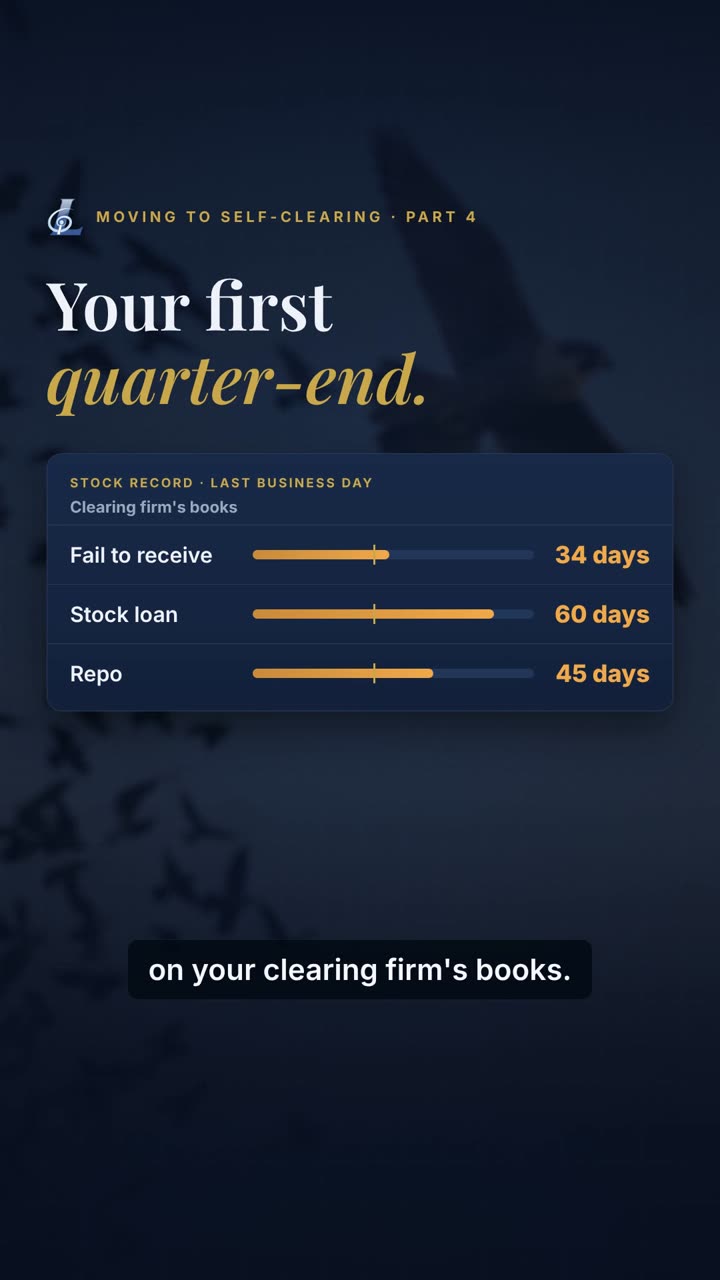
Once you clear your own trades, the quarterly securities count is yours. Part 4 opens on the last business day of a firm’s first quarter as a self-clearing firm, with a fail, a stock loan, and a repo all open past 30 days. It covers what the count asks for, the two clocks a fail runs on, and what an unresolved difference costs in net capital. Then it closes the series by putting the letters, the prime brokerage forms, and the quarterly count side by side.
What it covers
- SEC Rule 17a-13 in plain English: count, account, verify past 30 days, compare, and record differences within 7 business days
- Two clocks on one fail: Regulation SHO Rule 204 and the quarterly count
- What an unresolved short difference costs in net capital
- Monthly FOCUS filings, the compliance report, and what FINRA examiners keep finding
- The records to keep, and the confirmation requests that start arriving from other firms
- How QBS handles the sending and receiving sides of the count
- A three-point checklist
Transcript 889 words
It's the last business day of your first quarter as a self-clearing firm. On your stock record, there's a fail to receive that's been open thirty-four days. A stock loan, open sixty. A repo, open forty-five. Last quarter, those positions sat on your clearing firm's books. This quarter, they're yours. So what does the quarterly count want from you?
This is Moving to Self-Clearing, a four-part series on the regulatory work your clearing firm used to do. Part four: your first quarter-end.
When you cleared through someone else, the securities sat on their books, and so did the count. Now you hold them yourself. You carry your own fails. And if you start lending securities, loans and borrows join them. All of it meets in one rule, every quarter.
The rule asks for four things. First, count the securities you physically hold. Second, account for the ones you don't: securities in transfer, pledged, loaned, borrowed, failed to receive or deliver, or out on repo. Third, for anything that's been in one of those states for longer than thirty days, verify it. In practice, that means a confirmation to the other side. And fourth, compare it all with your records. Any difference you can't resolve goes into a security count difference account, within seven business days of the count.
Two more conditions. The count has to be made or supervised by people who don't handle those securities or keep those records. And no count can come less than two months, or more than four months, after the last one.
Fails run on two clocks. Rule 204 of Regulation SHO tells you when to close out a fail to deliver at the clearing agency: by the open of the next settlement day for a short sale, or the third settlement day for a long sale. The quarterly count doesn't close anything. It wants proof of what's still open after thirty days, including fails to receive, which Rule 204 doesn't cover.
There's a capital reason to move fast, too. An unresolved short difference comes off net capital: a quarter of its market value seven business days after you find it, half after fourteen, three quarters after twenty-one, and all of it after twenty-eight. And a position you can neither count nor confirm is treated as a short difference.
Your reporting changes too. A firm that clears or carries files FOCUS Part One every month, and Part Two every quarter. And the annual audit changes shape. Instead of an exemption report, you file a compliance report on your controls over net capital, customer protection, the quarterly count, and account statements, and your auditor examines it. FINRA's 2026 oversight report lists what examiners keep finding. Suspense items nobody tracks or ages. And reconciliations with outside parties that never get finished.
All of it has to be kept. Every confirmation you send and every reply you get is a communication: at least three years, the first two easily accessible. Your blotters, ledgers, and stock record: six years. And electronic records need a write-once format, or a complete time-stamped audit trail.
There's a second side, too. Once other firms owe you securities, or borrow from you, their confirmation requests start arriving at your door. Each one has to be matched to your books and answered.
So what does this look like without the rails? Confirmations go out by email, from a template, and a tracker spreadsheet holds the replies. One counterparty never answers, and nobody notices for three weeks. Another sends back its entire book: ten thousand rows, for the forty positions you asked about. And the difference you needed to record by day seven turns up on day nine.
QBS, our Quarterly Broker Statement, runs both sides of the count. On the sending side, you send a file of the loans, borrows, repos, and fails that have been open more than thirty days. QBS packages them by account or by DTC number, sends each counterparty its confirmation, and tracks every response. You can see what's still waiting, and for how long. Non-responses are flagged, so alternative verification starts in time. And when a counterparty answers with its whole book, QBS finds the positions you asked about.
On the receiving side, requests from other firms are indexed as they arrive. QBS checks each one against your positions. Matches are processed, and mismatches go to review. When both firms use QBS, matching positions pair up automatically. QBS keeps every confirmation and response for eight years. Loffa retains the records it processes. Your firm's own record-keeping obligations stay with your firm.
That's the work your clearing firm used to do, on both sides. FVD sends and answers the Letters of Free Funds. PBIN keeps the prime brokerage forms. QBS sends and answers the quarterly confirmations. One vendor review covers all three, and Loffa is SOC 1 and SOC 2 Type II audited.
Three things to take from this episode. One: put aged fails, loans, borrows, and repos on your quarterly count calendar now, before the quarter closes. Two: know which clock each fail is on. Three: decide where every confirmation and reply will be kept, and for how long.
That's Moving to Self-Clearing. We'll walk your compliance and operations teams through the letters, the prime brokerage forms, and the quarterly count, before your first trade clears. Email info@loffacorp.com.
Get new posts and videos
That’s the series
All four parts are out. We keep writing about clearing, settlement, and the rules behind them. Leave your email and we’ll tell you when the next post or video is out.
We use your email only to tell you when we publish. Unsubscribe anytime. See our Privacy Policy.
Planning a conversion now? Email info@loffacorp.com and we’ll walk your compliance and operations teams through the move.
These videos are for informational purposes only and do not constitute legal advice. For guidance on specific regulatory obligations, consult your counsel or compliance advisor.