Freefunds Verified Direct
Automating Letters of Free Funds for the world's top financial institutions. Replace manual letter exchanges with secure, auditable digital verification.
Part of Loffa's broker-dealer compliance automation platform and settlement workflow automation solutions.
The Problem
Manual Verification Is a Compliance Time Bomb
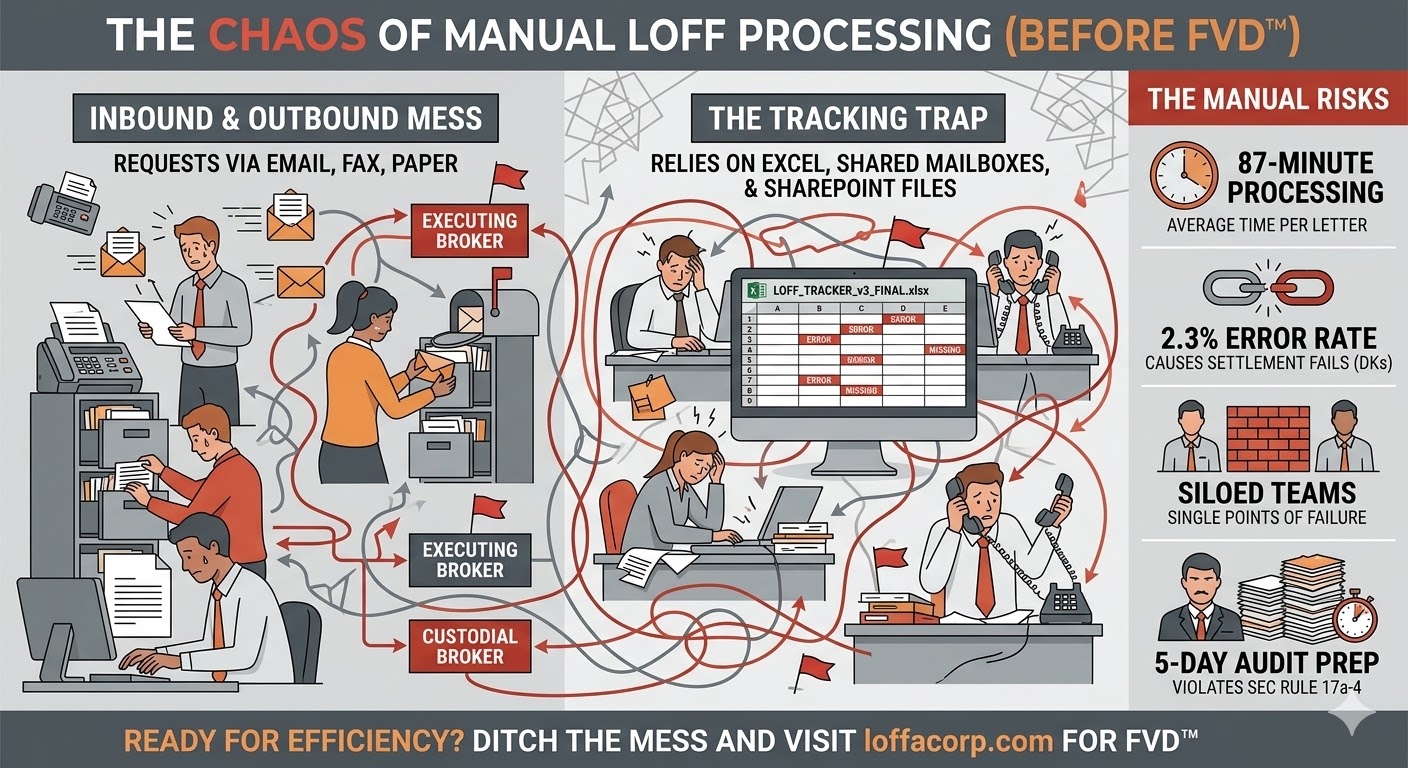
Under Regulation T, a security sold or delivered to another broker-dealer before the customer pays for it puts the cash account under a 90-day freeze. The exception in 220.8(c)(2)(ii) covers delivery to a cash account at another broker-dealer that holds enough to pay for it, and the executing broker may rely on that firm's written statement that the funds are there. That statement is the Letter of Free Funds. For decades, firms have exchanged these letters by mail, fax, and email -- a process that is slow, error-prone, and creates significant compliance exposure.
- ✗ Paper-based letters lost in transit or delayed by weeks
- ✗ Manual data entry introduces transcription errors
- ✗ No centralized audit trail for regulatory examinations
- ✗ Inconsistent verification timelines across counterparties
- ✗ Regulatory findings due to incomplete or missing records
The Solution
Digital Verification, End to End
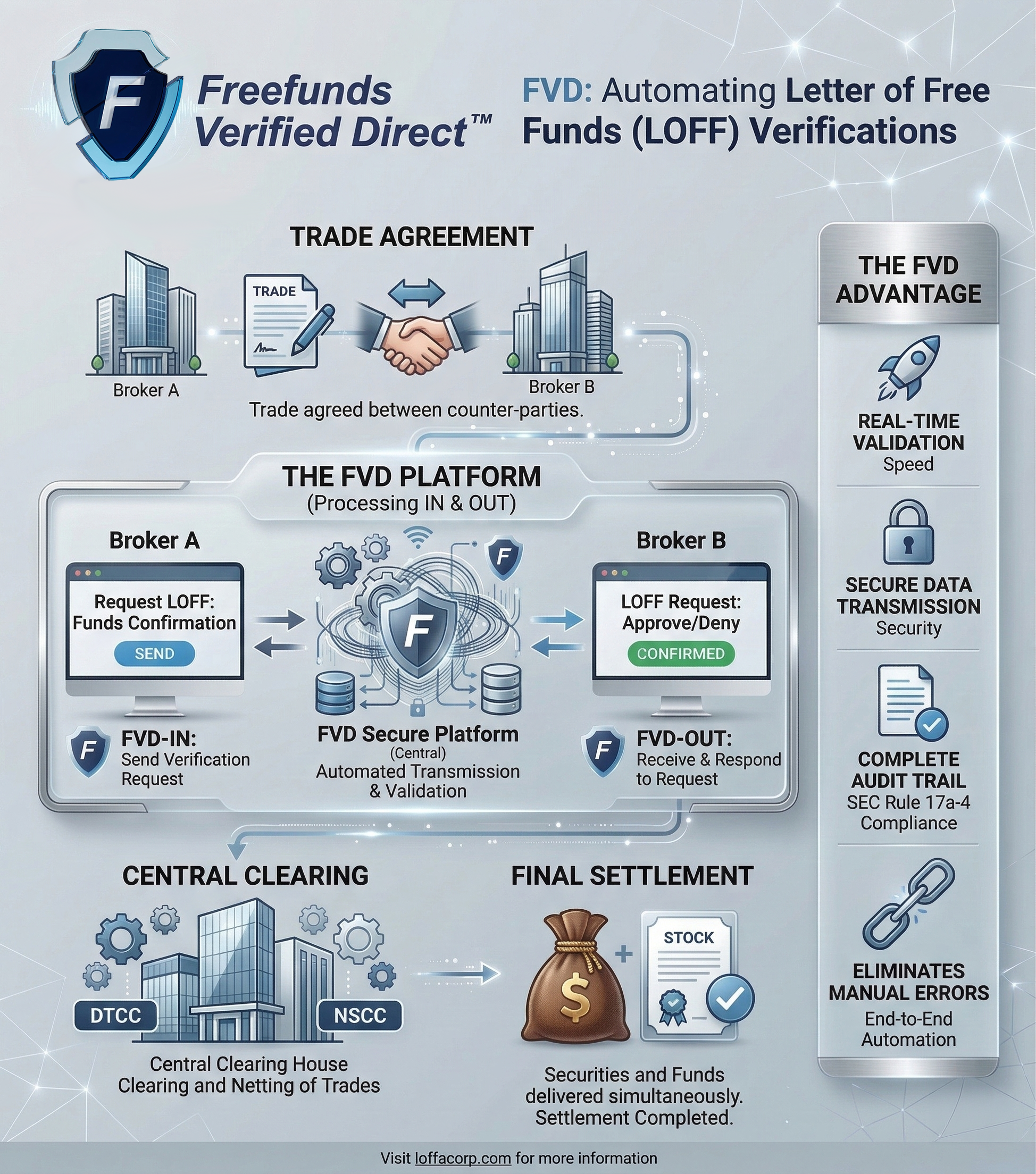
Freefunds Verified Direct replaces the entire manual letter process with a secure, digital verification workflow. Executing brokers send Letter of Free Funds requests electronically. Custodians and carrying brokers verify and respond through the same platform. Every interaction is logged, timestamped, and audit-ready. FVD works hand in hand with PBIN: once an F1SA for an account is on file in PBIN, FVD adds an exception for that account number and stops sending Letter of Free Funds requests for it, since a documented prime brokerage account doesn't need a letter.
- ✓ Secure digital submission and verification workflow
- ✓ Automated matching and exception handling
- ✓ Complete, immutable audit trail for every transaction
- ✓ Real-time status tracking and deadline monitoring
- ✓ Regulatory-ready reports generated on demand
- ✓ No Letter of Free Funds requests for accounts with an F1SA on file in PBIN
Capabilities
Key Features
Every feature designed to eliminate manual risk and accelerate compliance workflows.
Digital Verification
Replace paper letters with secure, encrypted digital verification between carrying and depositing brokers. Submissions are validated in real time with automated data integrity checks.
Automated Workflows
Configurable workflows that route verification requests, escalate exceptions, and trigger notifications automatically. Reduce manual touchpoints by up to 90%.
Real-Time Monitoring
Live dashboards track verification status across all counterparties. Deadline alerts and escalation triggers ensure nothing falls through the cracks during the verification cycle.
Compliance Records
Every verification is stored with full metadata -- timestamps, user actions, data snapshots, and response records. Eight-year WORM retention supports your SEC Rule 17a-4 obligations and keeps records ready for any examination.
Audit Trail
Immutable, timestamped log of every action taken in the system. From initial submission to final verification, every step is recorded and available for regulatory review on demand.
Integration Ready
RESTful APIs and secure file transfer protocols enable seamless integration with existing back-office systems, clearing platforms, and compliance management tools.
Record Retention
SEC Rule 17a-4 and Your Letter of Free Funds Records
A Letter of Free Funds lets a firm settle a DVP trade in a cash account without the 90-day freeze under Regulation T 220.8(c). The request and the custodian's response are records your firm keeps under SEC Rule 17a-4. FVD keeps them in write-once storage from the moment they are sent.
What FVD Keeps
Every Letter of Free Funds request, the custodian's response, each status change, and the user who made it. Each record carries its timestamps and the trade details on the letter.
How FVD Stores Them
Records are written once to WORM storage and cannot be changed or erased. A time-stamped audit trail records every action. FVD keeps them for eight years, well past the three-year minimum Rule 17a-4(b)(4) sets for communications. Firms that keep their own copies can ask for a shorter period.
When an Examiner Asks
Pull the full history of any letter on demand: the request, the response, and every action in between. No searching paper files, shared drives, or inboxes.
Loffa retains the records it processes; it is not your books-and-records keeper, and your firm's Rule 17a-4 obligations stay with your firm. Read the SEC Rule 17a-4 guide for Letter of Free Funds and DVP records, or the full walkthrough of SEC Rule 17a-4, Regulation T 220.8, and the Letter of Free Funds.
Outcomes
Measurable Impact on Your Operations
Firms that switch to FVD see immediate, quantifiable improvements in compliance efficiency and risk reduction.
90%
Reduction in Processing Time
What once took weeks of letter exchanges now completes in hours through digital verification workflows.
100%
Audit Trail Coverage
Every verification is recorded with complete metadata. No more missing records or incomplete documentation during examinations.
Zero
Paper Dependencies
Fully digital workflow eliminates mail delays, lost letters, and the transcription errors that come with manual data entry.
How It Works
The FVD Workflow, Both Sides of the Loop
FVD digitizes the Letter of Free Funds exchange end to end. Follow the step-by-step operational flow from either side of the transaction.
FVD-S · Send Workflow
The executing broker's side. From DVP trade initiation to standardized LOFF generation, encrypted transmission to the custodian, and WORM archival — a 7-step flow that meets the T+1 clock.
View the Send workflow →FVD-R · Receive Workflow
The custodian and carrying broker's side. Receive inbound letters on one channel, AI-index even email and fax submissions, verify in context, and respond in minutes — with your own complete audit trail.
View the Receive workflow →Watch
Automated Isn't Free. It's Unpriced.
A mail merge and a spreadsheet automate one task: sending the request. This short explainer follows one missing message through IT, operations, compliance, and legal, and shows where the cost of a do-it-yourself verification process actually lands.
Automated Isn't Free. It's Unpriced. Motion-graphic explainer, 2:36, captioned.
Watch
The Letter of Free Funds After Self-Clearing
Part 2 of our series Moving to Self-Clearing. When a firm starts clearing its own trades, the letters its clearing firm used to send become its job. The episode covers the Regulation T rule behind the letter, the four checks that decide which trades need one, how each letter reaches the right desk, and how FVD-S and FVD-R handle both sides. Narrated and captioned, 6:22.
Moving to Self-Clearing, Part 2: The Letter of Free Funds. 6:22, captioned.
See FVD in Action
Schedule a personalized demo and see how Freefunds Verified Direct can transform your Letter of Free Funds workflow.