Moving to Self-Clearing: The Regulatory Work Your Clearing Firm Used to Do

A broker-dealer gets approved to self-clear. The DTC and NSCC applications are in, and the project plan has workstreams for net capital, the reserve computation, and the stock record. Then someone in compliance asks a plain question about the DVP business: when a client's custodian is another broker-dealer, who sends the Letter of Free Funds?
Until now, the answer was the clearing firm. Part of what a correspondent pays its clearing firm for is this regulatory work, done quietly in the background. After conversion day, it's yours. The Letter of Free Funds (LOFF) is just the first item on a list that grows as your business does.
This post walks through that list in the order most firms meet it: the letters you send as the executing broker, the letters you receive once you custody assets, the prime brokerage forms, and the quarterly count. It ends with a checklist for the transition plan.
Who Sends the Letter After the Move
The firm that carries the customer's cash account does the Regulation T work on it. Under a fully disclosed clearing arrangement, that's the clearing firm. That's why your clearing firm sent LOFFs for your DVP trades, and why your carrying agreement under FINRA Rule 4311 spelled out who did what. Paragraph (c)(1) of that rule requires the agreement to allocate both the extension of credit and the receipt and delivery of funds and securities. (If you haven't pulled that agreement out of the file lately, here's what an examiner looks for in one.)
Once you self-clear, that firm is you. The SEC staff addressed the split case in its 2003 no-action letter to Loffa: "When the executing broker is not self-clearing, the broker-dealer that clears and settles the trade would make the request." So if one entity in your group executes and another clears, the clearing entity sends the letters.
The rule hasn't changed. Under Regulation T 220.8(c)(1), a nonexempted security sold or delivered to another broker or dealer before the customer pays for it in full puts the cash account under a 90-day freeze. Under 220.8(c)(2)(ii), no freeze applies if the security went to another broker or dealer for deposit in a cash account holding enough funds, and you may rely on that firm's written statement accepted in good faith. That statement is the LOFF. Under T+1, the payment period ends on the third business day after trade date. Our 2026 guide to Rule 17a-4, Regulation T 220.8, and the Letter of Free Funds covers the rule in full.
Which Trades Need a Letter
Not every DVP trade requires a letter. The filter is short, and it's worth writing down before your first trade file goes out:
- The custodian is a broker or dealer. The freeze applies to sales or deliveries to another broker or dealer. A DVP delivery to a bank or trust company custodian doesn't trigger it, so you don't need the letter. That holds only when the custodian is itself a bank or trust company. A bank's broker-dealer affiliate is a broker-dealer, so check the entity on the settlement instructions.
- The security is nonexempted. U.S. government securities are exempted under Section 3(a)(12) of the Exchange Act, which pulls T-bills, notes, and bonds out. Equities and corporate bonds stay in.
- Municipals are a policy call. Municipal securities count as exempted too, but some firms verify them anyway. A general obligation bond rests on a municipality's power to tax, while a revenue bond depends on what one project earns; 2008 showed that bond insurance is only as strong as the insurer. If your data can't tell a general obligation from a revenue bond, including all munis is the simpler rule. Either way, write the choice into your procedures.
- The account isn't documented prime brokerage. With an SIA-150 and an F1SA on file for the account, you don't need the letter.
In practice, the filter runs on data you already produce for settlement: the custodian on the settlement instructions, the security type, and the account. The hard part isn't the logic. It's knowing where each custodian wants its letters. Some large custodians take them at several different desks, depending on the account number.
The Other Side of the Letter
Once your firm custodies assets for customers who trade away, the letters start coming from the other side. Other executing brokers send you LOFFs, each asking for a written statement that the account holds enough funds. Some arrive through a network. Plenty still arrive by email and fax.
Each one is a small deadline. The executing broker needs your answer before it delivers the security, and under T+1 that window is one business day. Both halves of the exchange, the request you received and the answer you sent, are communications under SEC Rule 17a-4(b)(4). Keep them at least three years, the first two in an easily accessible place.
Prime Brokerage Forms, on Both Sides
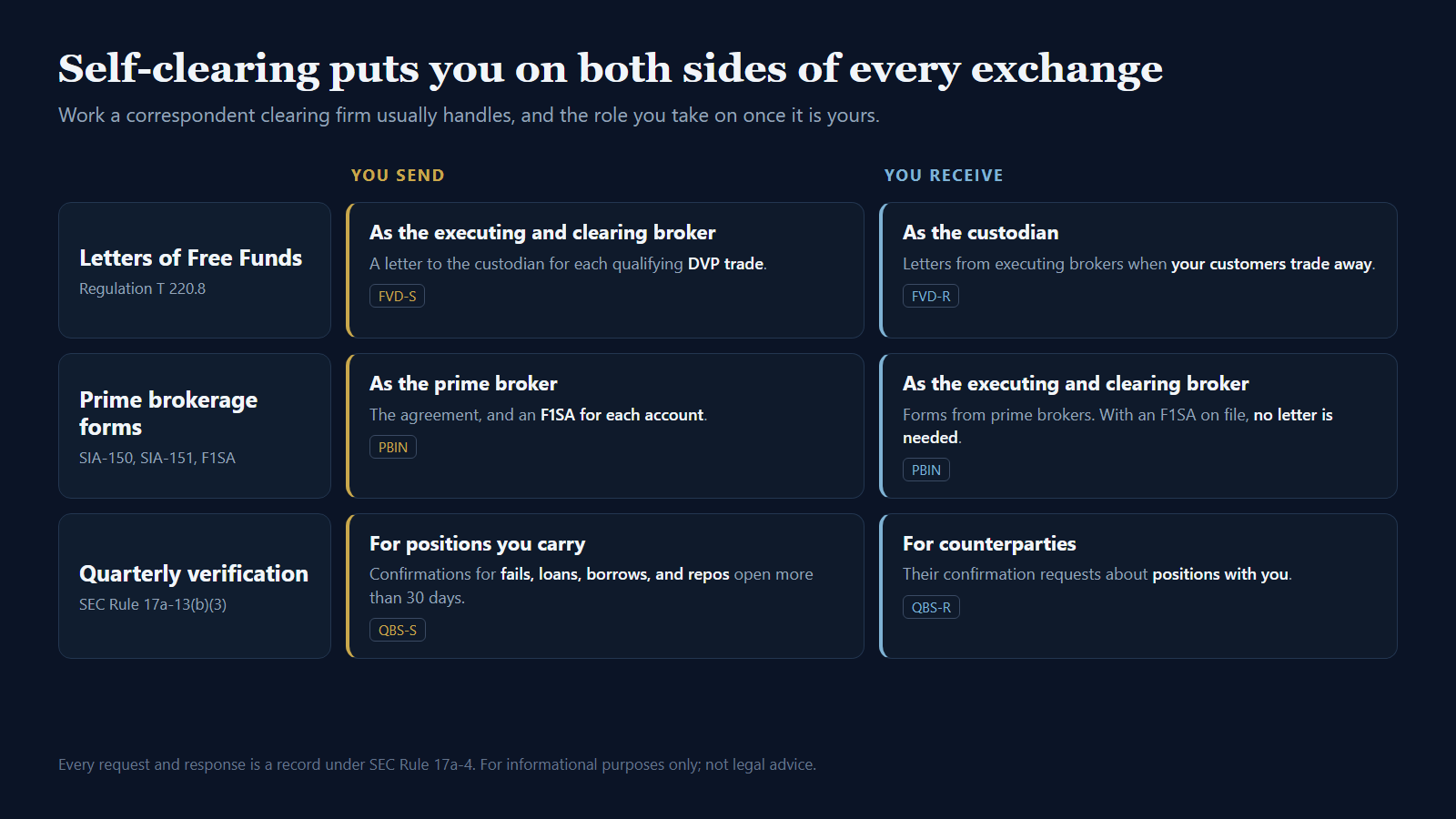
Prime brokerage is where the LOFF's bigger sibling lives. When a hedge fund or adviser tells you an account you execute for is prime brokerage, the prime broker should send you the SIA-150 and an F1SA (Form 1 Schedule A) for each account under it. With those on file, trades for those accounts don't need letters. Without them, you're back to one LOFF per trade. A missing F1SA can turn one account into 2,500 letters a month.
If you later become a prime broker yourself, the flow flips. Your firm sends the SIA-150 and F1SAs to the executing brokers where your clients trade.
Add this item if your plan includes omnibus accounts. Commingling several customers in an omnibus account makes it harder to deliver a trade confirmation under SEC Rule 10b-10 for each one. An examiner who sees one tends to keep asking questions until the confirmation path is clear.
Fails, Loans, and the Quarterly Count
A self-clearing firm handles its own fails and often adds securities lending once the clearing operation is live. Both trigger SEC Rule 17a-13 requirements. Each calendar quarter, the firm counts what it holds and accounts for items not physically in possession. Under 17a-13(b)(3), you verify any security that has been in transfer or transit, pledged, loaned, borrowed, failed to receive or deliver, or subject to a repurchase or reverse repurchase agreement for more than 30 days. Unresolved differences must move into a security count difference account within 7 business days.
This comes up at your first quarter-end as a self-clearing firm. Fails that age past 30 days need verification, and so do loans and borrows open that long. For the count itself, see Exam Prep for the 17a-13 Quarterly Securities Count.
Decide the Integration Before the Vendor Review Starts
Every process needs data from your books, and how you hand that over shapes the project. A file drop over SFTP fed by a nightly batch of qualifying trades gives your security team a known, narrow set to review. A live API into your order management or back-office system brings more systems into scope, raises access questions, and lengthens the review. Neither choice is wrong. They have different timelines, so pick one before the review starts, not halfway through it.
This applies to messages sent to counterparties too. Standardized responses with defined statuses are simpler to supervise and easier to defend in an exam than free-form replies typed by whoever was handling the queue that day.
Where Loffa Fits
Each of the roles above maps to one Loffa module. They run on their own, and they share status when you use more than one.
- Freefunds Verified Direct (FVD) covers the letters. On the send side, FVD-S takes your qualifying trades by secure upload or batch file, builds a standardized LOFF for each, and delivers it to the custodian: through the network, or by the email or fax a custodian outside the network prefers. Our operations team keeps the directory of where each custodian wants its letters. Every response comes back with a defined status, such as approved, trade unknown, or invalid account number, and supervisors see what's still open on a dashboard. On the receive side, FVD-R takes inbound requests on one channel and indexes email and fax submissions with AI. FVD keeps three years of letters in the application and eight years in total; older records come back on request, and firms that keep their own copies can ask for a shorter period.
- Prime Broker Interactive Network (PBIN) keeps the SIA-150, SIA-151, and F1SA for each relationship, on either side. Once an F1SA lands in PBIN for an account, FVD stops sending outgoing requests for it and declines incoming ones automatically.
- Quarterly Broker Statement (QBS) generates and tracks 17a-13(b)(3) confirmations for loans, borrows, repos, and fails open more than 30 days, flags non-responses, and tracks differences against the 7-business-day deadline.
Loffa keeps a copy of every letter and form it handles so you have proof when an examiner asks. The requirement under SEC Rule 17a-4 to keep those records stays with your firm, not the vendor.
A Checklist for the Transition Plan
- Read your current carrying agreement and list every Regulation T, confirmation, and recordkeeping function your clearing firm performs for you. Each one moves to you on conversion day.
- Write down your LOFF filter: broker-dealer custodians only, nonexempted securities, your municipal policy, and documented prime brokerage accounts excluded.
- Choose how trade data reaches your vendors, batch file or API, before your vendor review begins.
- Set up the receive side before you custody assets for customers who trade away.
- Collect SIA-150s and F1SAs from prime brokers for your prime brokerage clients before their trades start clearing through you.
- Put aged fails and any securities lending on the 17a-13 calendar for your first quarter-end.
- Confirm retention for every letter and form: at least three years, the first two easily accessible, in WORM storage or a system with a full audit trail.
Self-clearing puts you in control of your own settlement. It also hands you the paperwork your clearing firm used to handle without much fanfare. None of this is new to the industry. The risk lies in discovering it on conversion day instead of catching it during project planning.
If you're planning the move to self-clearing, contact Loffa Interactive Group. We'll walk your compliance and operations teams through the letters, the prime brokerage forms, and the quarterly count before your first trade clears.
This post is for informational purposes only and does not constitute legal advice. For guidance on specific regulatory obligations, consult your counsel or compliance advisor.
Related reading: SEC Rule 17a-4, Regulation T 220.8, and the Letter of Free Funds: A 2026 Guide, What an Examiner Wants to See in a Carrying Agreement File, and 2,500 LOFFs a Month: What a Missing F1SA Costs the Executing Broker.