2,500 LOFFs a Month: What a Missing F1SA Costs the Executing Broker

The letters started piling up against a single account relationship. An executing broker we work with sent Letters of Free Funds to the other firm at more than 100 a day. At that run rate, one account was on track to generate roughly 2,500 LOFFs a month.
The activity looked like prime brokerage. The trades were flowing, settlement patterns fit, and the other firm's operations team saw the volume too. But there was no Form 1 Schedule A on file, no SIA-150 to back it up, and after a week of follow-ups nobody answered either question: is this a prime brokerage account, or if not, will you respond to the LOFFs?
It isn't just a backlog. Each day the relationship runs without paperwork, the executing broker carries risks it thinks aren't there. Here is why, and how to fix it.
Why a missing form means a letter on every trade
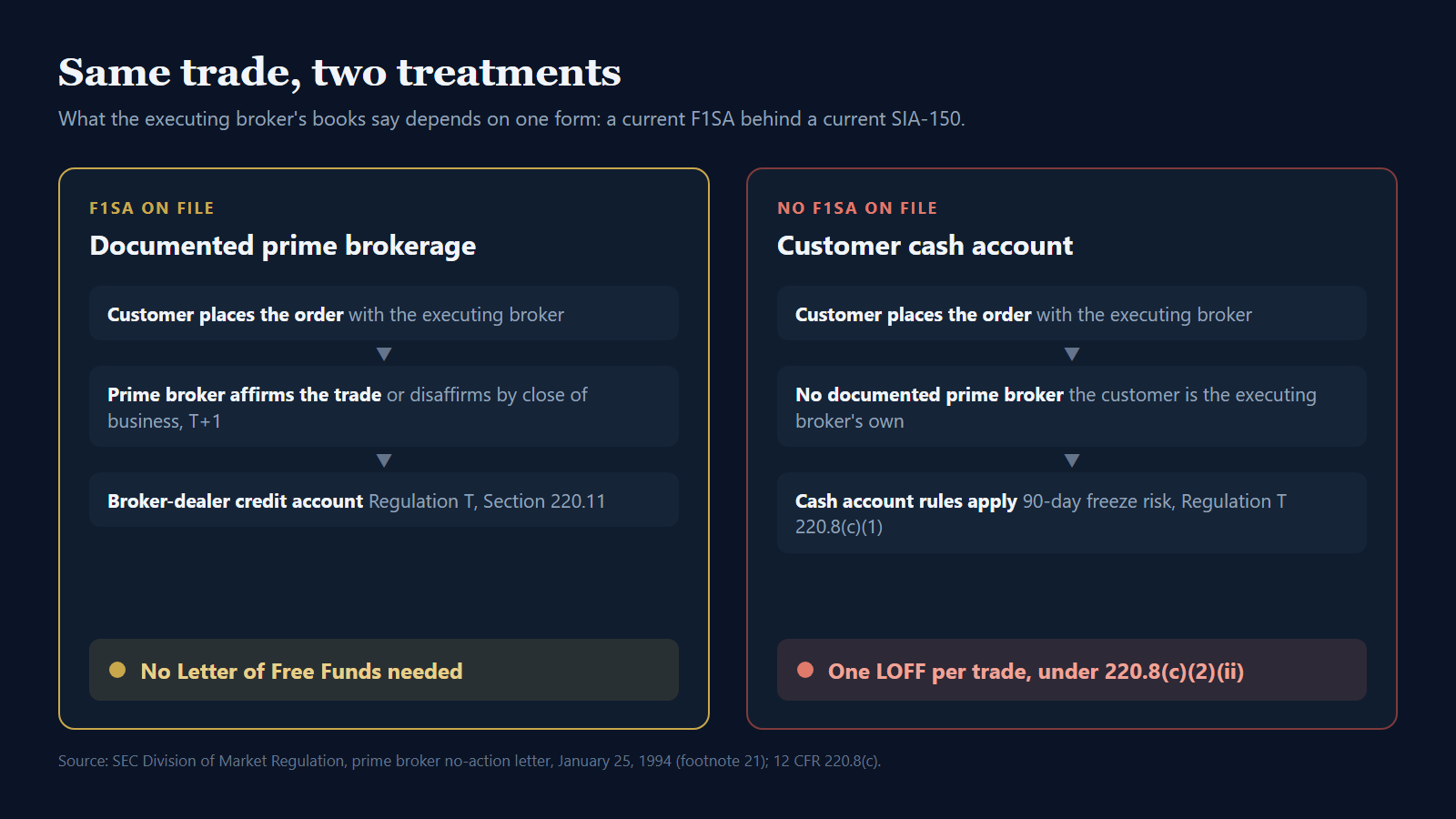
A no-action letter from SEC staff on January 25, 1994 still drives U.S. prime brokerage. When a long list of conditions is met, an executing broker and its prime broker can treat the customer's account as a broker-dealer credit account under Section 220.11 of Regulation T. Footnote 21 spells out the payoff: if those conditions are met, "a letter of free funds would not be required for transactions in the Account that are paid for through the customer's account at the prime broker."
Remove those conditions and you're left with what's on the books: a customer cash account. Regulation T applies fully here. Under 12 CFR 220.8(c)(1), selling or delivering a security before payment wipes out delayed payment privileges for 90 days. The exception in 220.8(c)(2)(ii) covers a purchased security delivered to another broker for deposit in a cash account that holds enough funds to pay for it, and lets the executing broker rely on that broker's written statement, accepted in good faith. That statement is the LOFF.
The math holds up: documented prime brokerage means no letters; undocumented status requires one LOFF for every single trade. That turns a busy account into a busy queue of requests.
The 1994 letter doesn't name the SIA forms. They're how the industry puts its conditions on paper: the SIA-150 is the base agreement between the prime broker and the executing broker, and the F1SA ties specific customer accounts to that arrangement. Without a current F1SA for the account, the executing broker has nothing that shows the trade belongs to a documented prime brokerage relationship.
The LOFF is the part you can see
The letters are visible because someone has to send and chase every one. The less visible problem is what else the executing broker gives up when it can't verify the paperwork. The 1994 letter and FINRA's interpretations split the obligations carefully between the two brokers, but that split only holds when the arrangement is documented.
| Obligation | Documented prime brokerage | No F1SA on file |
|---|---|---|
| Regulation T | Account treated as a broker-dealer credit account under 220.11 | Customer cash account at the executing broker; LOFF needed to avoid the 90-day freeze |
| Trade confirmations, Rule 10b-10 | Executing broker may send them in care of the prime broker, on the customer's separate written instruction | Executing broker sends them directly to the customer |
| Customer protection, Rule 15c3-3 | Executing broker carries a broker-dealer fail in the prime broker's name, for the benefit of the customer | The customer is the executing broker's own customer |
| Disaffirmed trades | Prime broker must settle unless it disaffirms by close of business on trade date plus one | No prime broker standing behind the trade at all |
Trade confirmations are where people get this wrong most often. The Rule 10b-10 obligation stays with the executing broker; it never moves to the prime broker. Condition 11 of the letter requires the executing broker to send a confirmation for each trade directly to the customer, unless that customer gave written instructions in a document separate from the prime brokerage agreement to have them sent in care of the prime broker. The prime broker then sends its own next-day notification on top of that. No documentation and no instruction means the executing broker confirms directly.
Customer protection works the same way. FINRA's interpretation of Rule 15c3-3, item (a)(1)/05, says an executing broker treats a prime brokerage account as a broker-dealer fail in the name of the prime broker for the benefit of the customer. If that prime broker disaffirms the trade, the executing broker must treat the account as its own customer. Condition 9 goes further for short sales: it treats a disaffirmed short sale as if executed in a customer margin account at the executing broker.
Then there's condition 16, which tends to end the argument. Broker-dealers may not engage in prime brokerage activity with a party they "actually know or have reason to know" is not in compliance with the letter. A week of unanswered requests for an F1SA means you have reason to know something. Continuing to book trades as prime brokerage and hoping the paperwork turns up is the position you'd least like to explain to an examiner.
The letter also expects both brokers to keep copies of their prime brokerage contracts "in an easily accessible place" and produce them on request. If the F1SA isn't in the file, it can't be produced.
An escalation path that actually works
This doesn't mean the relationship itself is broken. Often the paperwork just got stuck between two operations teams or the right contact moved on. The fix involves making it easy for the other side to answer and clearly stating what happens if they don't, without issuing a threat. This sequence worked in the case above.
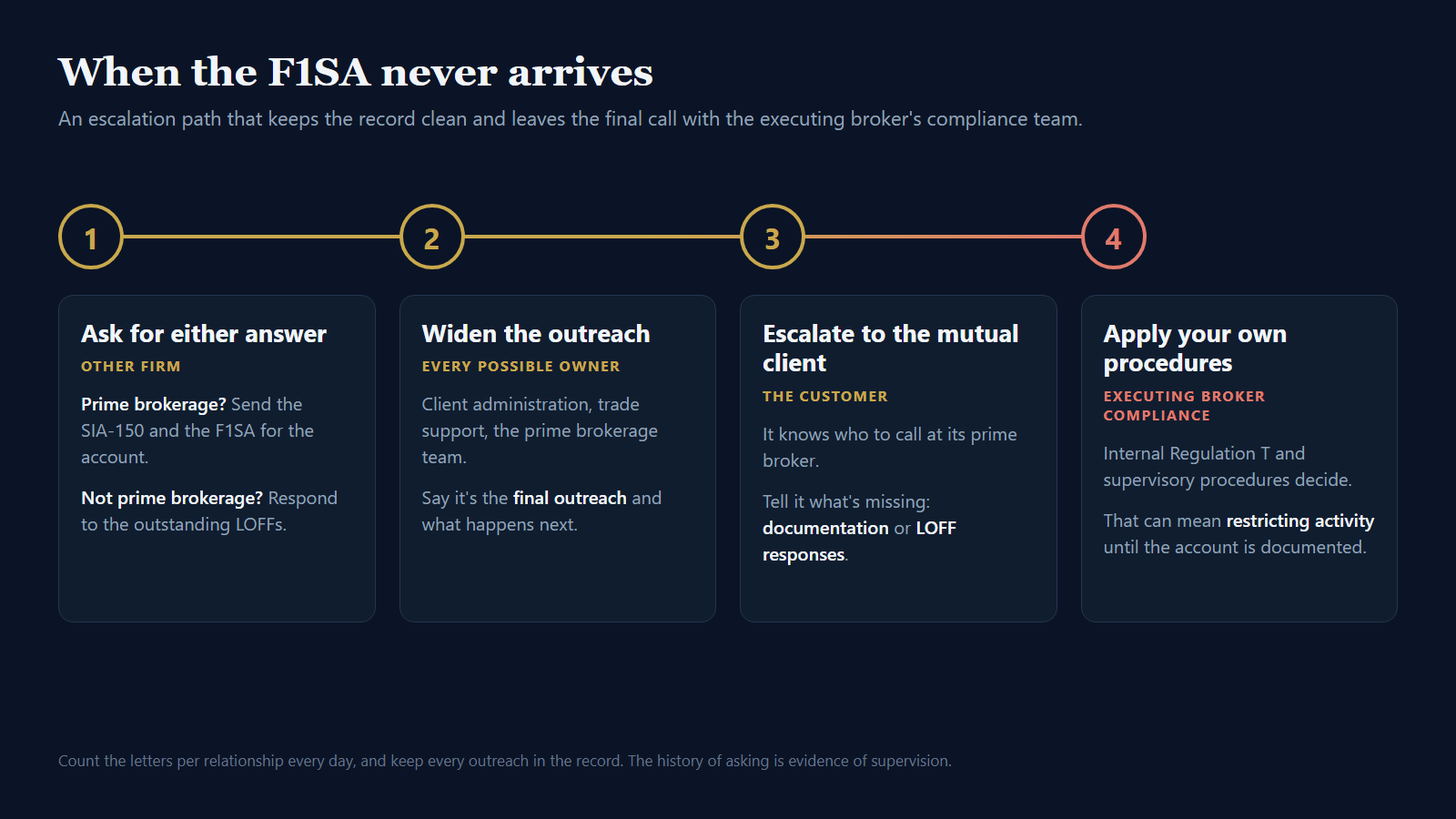
- Ask for either answer. Give the other firm two ways out. If it's prime brokerage, send the SIA-150 and the F1SA for the account. If not, respond to the outstanding LOFFs. Either one resolves the treatment question.
- Widen the outreach. When named contacts go quiet, copy everyone who might own the account: client administration, trade support, or the prime brokerage team. Say plainly that this is the final outreach before escalation within your firm, and say what could happen next.
- Escalate to the mutual client. The customer usually knows exactly who to call at its prime broker, and it has the most reason to get the paperwork done. Tell it what's missing: either the prime brokerage documentation or a response to the LOFFs.
- Apply your own procedures. If neither path resolves, your internal Regulation T and supervisory procedures decide what happens next. That can include restricting activity in the account until it's properly documented. The call belongs to the executing broker's compliance team. A vendor can recommend that step. It cannot make it.
Two habits make this sequence stick. Count LOFFs per relationship every day; seeing another 100-plus letters today moves people in a way that "documentation is outstanding" never does. Keep the outreach itself as part of the record, since the history of asking serves as evidence of supervision.
Where PBIN and FVD fit
Prime Broker Interactive Network (PBIN) keeps the SIA-150, SIA-151, and F1SA for every relationship in one place, shared with the counterparties that sign them. It rejects an F1SA until the underlying SIA-150 is verified first. On the receiving side, it indexes incoming agreement forms so a document that arrives by email doesn't sit in an inbox.
Freefunds Verified Direct (FVD) handles the letters: it sends each LOFF, tracks the response, and keeps a timestamped record of every request. The two systems are connected. Once an F1SA lands in PBIN for an account, FVD stops generating outgoing requests and automatically declines incoming ones. In a case like this, the day the paperwork arrives is the day the queue stops growing.
What to check this week
- Pull a count of LOFFs by counterparty account for the last 30 days. Dozens daily usually mean a documentation problem, not a funding one.
- For every account you book as prime brokerage, confirm there's a current F1SA behind a current SIA-150. "We've always treated it that way" isn't documentation.
- Check how Rule 10b-10 confirmations go out for those accounts and that you hold the customer's written instruction wherever they go in care of the prime broker.
- Write down when an unanswered request becomes an escalation to the customer. A date on a calendar beats a feeling that it's been a while.
A missing F1SA looks like a small problem on the desk. One form, one account. It quietly turns a prime brokerage relationship into an ordinary customer account with all of the executing broker's obligations switched back on. The LOFF count is just the meter running. If your prime brokerage documentation still lives in shared drives and email threads, contact Loffa Interactive Group. We can walk through how PBIN and FVD keep the paperwork and letters in step.
This post is for informational purposes only and does not constitute legal advice. For guidance on specific regulatory obligations, consult your counsel or compliance advisor.
Related reading: Missing Prime Broker Agreements and Managing SIA-150, SIA-151, and F1SA Documentation.