Exam Prep for the 17a-13 Quarterly Securities Count, Phase by Phase
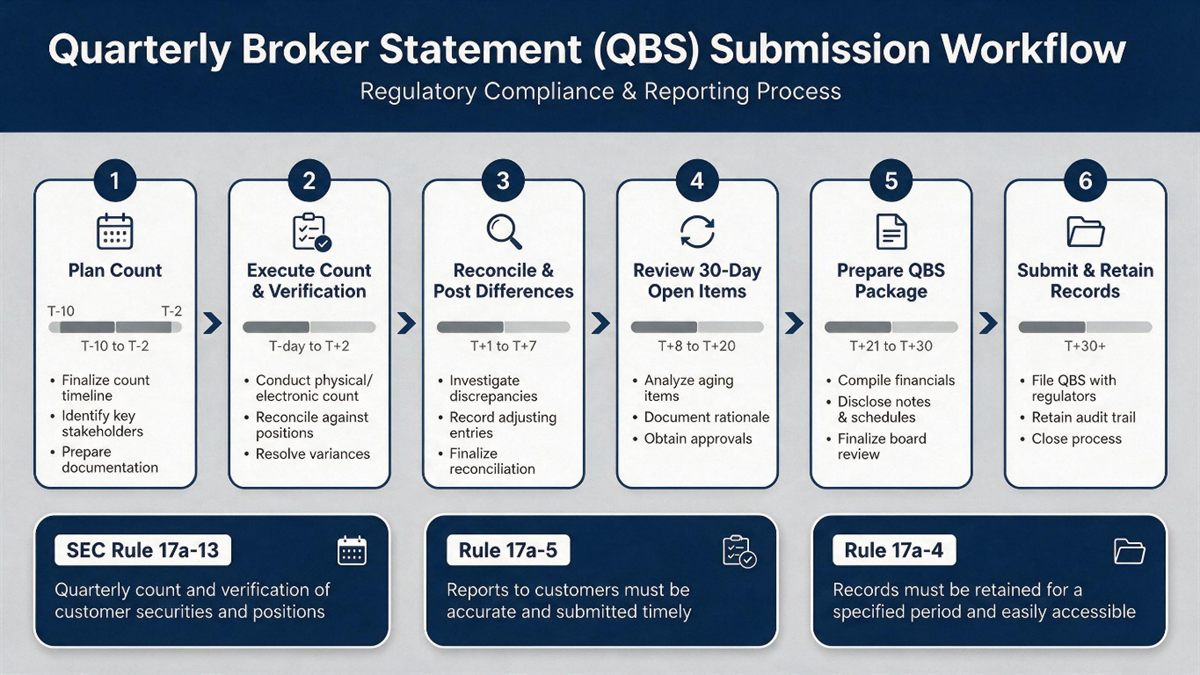
An examiner does not expect a perfect count. They expect a controlled one. Under SEC Rule 17a-13, a broker-dealer holding securities must count them at least once each calendar quarter. The firm also has to account for positions it controls but does not hold and verify any that have sat in transfer, transit, loan, borrow, pledge, deposit, or fail status longer than 30 days. It then compares all of this against the books and records every unresolved difference within 7 business days. The rule reads as one obligation. In practice, it is a calendar where the evidence has to line up.
This post walks through the quarter in six phases: what the rule asks for at each step, what an examiner expects to find, and where Loffa's Quarterly Broker Statement (QBS) fits. The day markers are a working cadence, not a regulatory deadline, except where the rule sets one.
Phase 1: Plan the count (T-10 to T-2)
The first control is the date. Rule 17a-13 requires a count at least once each calendar quarter, plus a spacing rule firms often miss: no count may fall within 2 months of or more than 4 months after the prior one. A March 31 count followed by May 15 fails that test, as does one slipping to August 15. Lock the date first, then set the scope.
- Pick a date 2 to 4 months after the last count.
- List every position: physical holdings, depository accounts, custodian positions, and anything in transfer, transit, pledge, loan, borrow, deposit, repo, or fail status.
- Name the owners. The rule requires that the count be made or supervised by people whose regular duties do not include responsibility for the care and protection of the securities, so the custody team cannot supervise its own count.
Where QBS fits: it enforces the 2-to-4-month spacing on the count schedule and applies separation-of-duties controls to keep the supervising principal independent of custody.
Phase 2: Count and verify (T-day to T+2)
The rule lists three separate activities in the count itself. Physically examine and count what the firm holds. Account for positions it controls but does not hold by comparing supporting detail records to ledger control accounts. Verify, directly with the counterparty, every position that has been in transfer, transit, pledge, loan, borrow, deposit, repo, or fail status for longer than 30 days. The third activity is where confirmation letters go out; the record of that mailing starts the trail an examiner follows later.
- Count physical positions in-house and reconcile depository and custodian positions to the stock record.
- Pull the population of positions open more than 30 days and send the 17a-13(b)(3) confirmations as part of the count, not after it.
- Log what went out, to whom, and when. A confirmation without a send record is a claim, not evidence.
Where QBS fits: it aggregates borrows, loans, repos, reverse repos, and fails across the stock record. It generates (b)(3) confirmation letters for positions open 30 days or longer and time-stamps each one as it goes out.
Phase 3: Reconcile and record differences (T+1 to T+7)
The rule's one hard clock runs here. Compare the count results and verification outcomes to your firm's records, investigate mismatches, and log every unresolved difference in the securities record difference account no later than 7 business days after the count. Timing breaks, missing tickets, or settlement lags explain most mismatches. The explanation does not stop the clock. Anything still open on day 7 gets recorded while resolution work continues from there with a visible trail.
- Match count results to the stock record position by position.
- Investigate each break. Keep the working notes; they are part of the record.
- Post unresolved differences to the difference account by the 7-business-day deadline, and note who approved it.
Where QBS fits: it flags count mismatches, watches them through the 7-business-day deadline, and logs every unresolved difference in the securities record difference account with an audit trail.
Phase 4: Chase the 30-day items (T+8 to T+20)
Confirmations arrive slowly, and some never do. This phase covers what happens to each open item after the letter went out: the response, the non-response, the follow-up, and the alternative verification procedure when a counterparty stays silent. A non-response isn't a resolution, and a list of aged items with no narrative is one of the first things an examiner flags.
- Run an aging report for every position still open past 30 days.
- For each item, log why it remains open, what action is underway, who owns it, and when you expect resolution.
- Escalate items that aren't moving to the supervising principal and compliance, then record that escalation where an examiner can find it.
Where QBS fits: it tracks counterparty responses, flags non-responses for follow-ups or alternative verifications, and records the owner, timestamp, and escalation for each open item.
Phase 5: Assemble the record (T+21 to T+30)
By month-end, the quarter's evidence needs to sit in one indexed set, ready when requested—not a reconstruction project started after the document request arrives. An examiner expects that set to have five distinct parts.
- A cover memo listing the quarter, count date, and names of those who made and supervised the count.
- The count workpapers plus reconciliations from depositories and custodians.
- Reconciliation schedules with difference-account detail and the posting date.
- An open items report for positions over 30 days that includes narratives and escalations for each item.
- A dated sign-off by the supervising principal.
For a carrying firm this record does double duty. The firm's annual compliance report under Rule 17a-5 covers Rule 17a-13, and the independent accountant examines that report. The auditor and examiner both look for those same five parts.
Where QBS fits: the confirmations, responses, count records, and difference resolutions sit together in one place. The system keeps a time-stamped audit trail for each step, letting the firm assemble the package from those records rather than digging through inboxes.
Phase 6: Retain it (T+30 onward)
The last phase is the least visible, and it fails quietly. Rule 17a-4 sets how long you keep the firm's records; this count package counts as one of those records. The workpapers, confirmations and responses, difference-account entries, and exception logs all have to be retrievable when a request lands—sometimes several quarters later. Examiners don't just test if the records exist. They test whether someone can pull them up in order without hunting.
Where QBS fits: it stores processed items in WORM storage with a time-stamped audit trail, retrievable in seconds. The firm's books-and-records obligations under Rule 17a-4 remain the firm's. QBS keeps its part of the record ready.
Red flags examiners find first
- Count dates that ignore the 2-to-4-month spacing rule.
- A population missing a control location or status category, so the firm counted the wrong thing.
- Differences carried from quarter to quarter with no posting date and no explanation attached.
- 30-day items listed on a report that shows no follow-up, escalation, or resolution.
- A count made or supervised by people responsible for the securities themselves.
- No trail connecting the package back to the count sheets, stock record, difference account, and its resolution.
Where to start
If you still run the quarterly count on a spreadsheet, via mail merge, or in a shared inbox, proving that calendar is hard even when every step was done. The first fix isn't the count itself. It's the record of the count: one place where the schedule, confirmations, differences, and sign-offs are captured as work happens. Contact Loffa Interactive Group to walk through your current 17a-13 cycle against these six phases and see what QBS records at each one.
Related reading: 17a-13 Is a Procedure Test, Not a Paper Exercise and Why 30-Day Open Positions Create the Hardest Questions Under 17a-13.