Friday Afternoon and the LOFFs Come Due
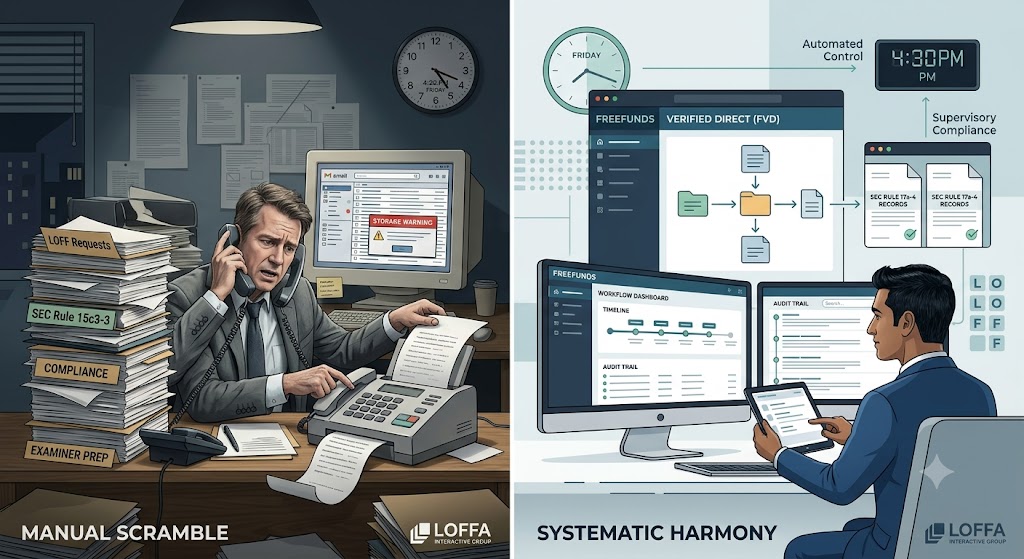
It is late Friday afternoon and the queue is full of free credit balance requests. The carrying broker needs verification to complete its reserve computation. The depositing broker needs a defensible record that it asked, verified, and retained. Operations needs to know where every Letter of Free Funds (LOFF) lives, who touched it, and whether the trail will stand up when someone asks for proof.
This is the moment SEC Rule 15c3-3 stops being a paragraph in the manual and becomes a question of records. The rule expects firms to protect customer assets, which includes confirming that free credit balances held at other firms are real, reconciled, and controlled. On paper, the LOFF process satisfies that obligation. In practice, the LOFF process only works if the evidence is complete.
What "Due" Really Means
When the LOFFs come due, it is not only about getting the letters out. It is about showing that each request was issued, answered, reviewed, and retained in line with the firm's supervisory procedures and its Rule 17a-4 recordkeeping obligations.
For each request, an examiner will want to see:
- The original free credit balance request, with a timestamp.
- The verification response from the carrying firm.
- The identity of the individuals who prepared and approved each.
- The retention record showing where the documents live and how long they are kept.
If any of those pieces are missing or scattered, the LOFF is no longer just a letter. It is a gap.
How Manual Workflows Fail
Most firms can describe their procedure. The hard part is proving it under pressure. When LOFFs move through fax machines, email inboxes, and shared drives, the workflow breaks in predictable ways:
- Requests sit in personal mailboxes instead of controlled queues.
- Responses are saved as PDFs in ad hoc folders.
- Supervisory review happens, but is not captured in a way anyone can query.
- Retention is assumed rather than demonstrated.
The firm may have done the work. But if the record is spread across systems, answering a document request becomes a reconstruction project instead of a report.
Why Friday Is Dangerous
Friday is dangerous because it compresses time. A request that feels like "we'll get to this next week" becomes "we must show this now" the moment it lands in an exam.
If the LOFF process depends on people remembering where things were saved, the firm is betting that the right inbox, folder, and shared drive will be in the same state months or years later. That is not a control. It is a habit. And a habit is exactly what fails when the deadline moves up and the person who knew where everything lived is on vacation.
Regulators are not testing whether the team is hardworking. They are testing whether the firm can demonstrate, quickly and reliably, that it verified free credit balances in a way that protects customers and satisfies Rule 15c3-3.
Where Freefunds Verified Direct (FVD) Changes the Story
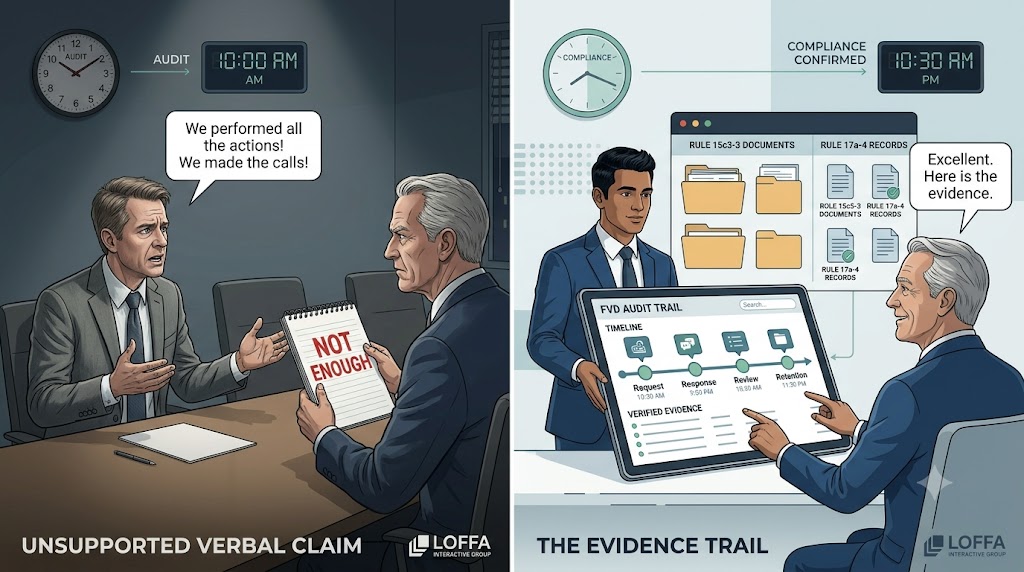
Freefunds Verified Direct is designed to make "due" visible and defensible, not just urgent. With FVD:
- Requests are generated and sent digitally from a controlled workflow, not improvised from an email template.
- Responses arrive in the same system, tied to the originating request.
- Each review is time-stamped and associated with a specific user.
- The full LOFF record is held in a searchable, retention-aware repository under WORM storage.
The result is that the LOFFs do not just come due. They arrive, get processed, and are retained inside a system that answers an exam question with a query instead of a scramble. One point worth being precise about: Loffa retains the records it processes as evidence for your obligations. It is not your books-and-records keeper — that duty stays with your firm, and FVD is built to make discharging it provable.
The Cost of Getting It Wrong
When the LOFFs are due and the record is fragmented, the bill arrives in three places at once. Operations loses hours locating and stitching together documents. Compliance and legal have to defend a process they cannot see end to end. And the firm's reputation takes the hit that comes from looking disorganized on a matter that goes directly to customer protection.
The firm may be doing everything right. But in an environment where recordkeeping and off-channel communication failures have generated billions in penalties, "we did it" does not carry the weight it used to without "here is the evidence" attached.
If your LOFF process still relies on fax, email, and manual filing to prove free credit balances, the evidence trail is the place to start — before a Friday deadline makes the point for you. Contact Loffa Interactive Group to tighten the workflow, strengthen the supervisory record, and meet SEC Rule 15c3-3 with a verification you can show, not just describe.
Related reading: The Letter Arrived. The Record Better Be Ready. and Automated Isn't Free. It's Unpriced..