Turn T+1 Into an Ops Advantage, Not a Compliance Headache.
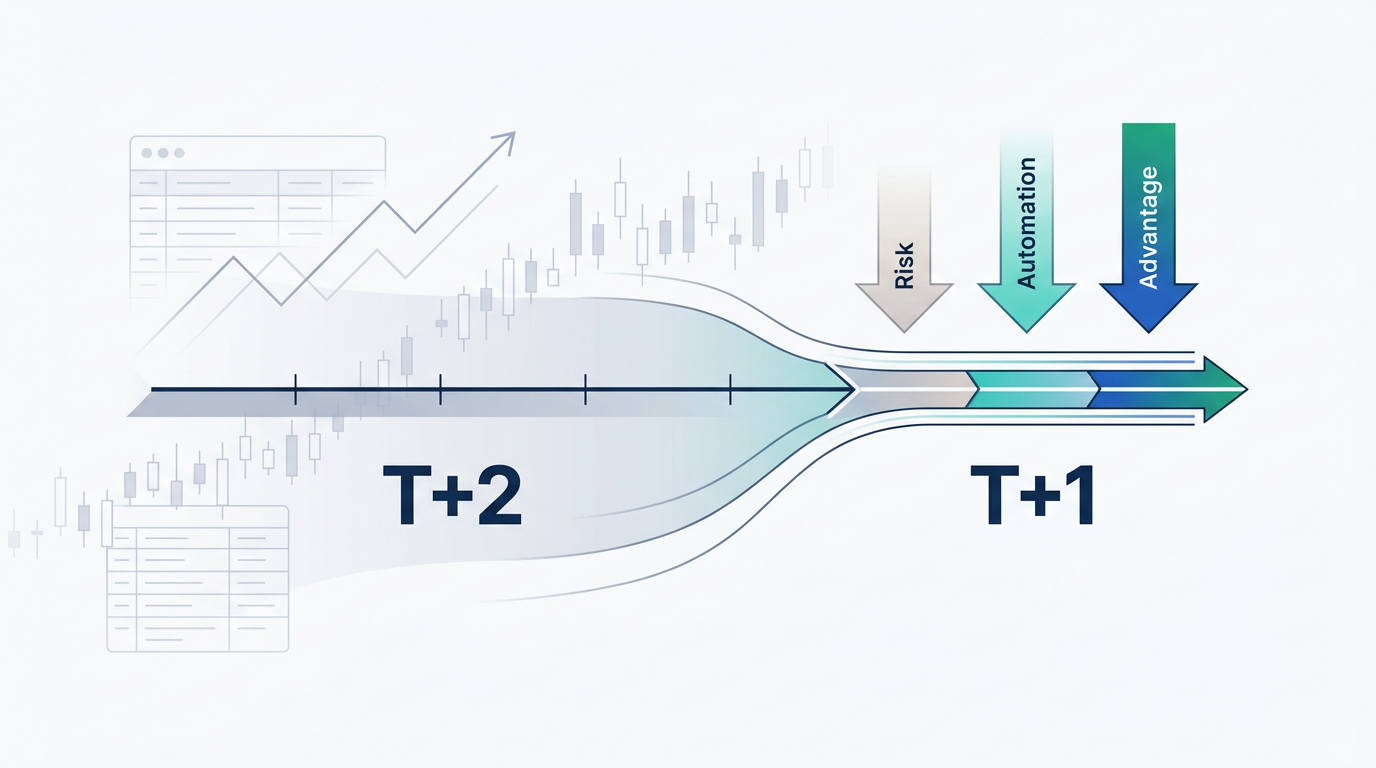
T+1 has compressed your funding, settlement, and exception‑handling windows, but it doesn’t have to be a permanent source of stress for your teams. With the right workflows, T+1 can actually sharpen your liquidity picture, reduce fails, and give your firm a real operational edge. For managing directors and heads of operations, the question is no longer whether you can comply with T+1 in theory-it’s whether your day‑to‑day processes can deliver consistency, transparency, and control at scale.
Why T+1 Broke Existing Cash Workflows
Most firms approached T+1 by “tightening” existing processes rather than redesigning them. The result is familiar: more pressure on the same people and tools, with less room for error.
-
Funding and free‑funds verification steps that once had an extra day of float are now crammed into a much narrower cycle.
-
Manual approvals, spreadsheet trackers, and email‑based sign‑offs add latency and create blind spots in the middle of that compressed window.
-
When funding cuts off or markets move intraday, your teams are left firefighting exceptions instead of managing a predictable process.
In practice, T+1 exposes every hand‑off that isn’t automated and every control that depends on “the right person seeing the right email at the right time.”
Where Manual Processes Create Real Fail Risk
From a distance, your T+1 workflow may look well‑documented and controlled. The real risk lives in the small manual decisions your teams make to keep things moving.
Common patterns include:
-
Spreadsheet‑driven control points. Free‑funds checks, intraday funding decisions, and exception queues live in workbooks that only a few people fully understand.
-
Email as a workflow system. Approvals, clarifications, and break resolutions rely on email threads that are hard to track, measure, or audit.
-
Shadow processes. Desk‑level “workarounds” appear to keep trades moving but bypass standard controls and make root‑cause analysis difficult when something breaks.
These manual steps may be barely manageable at normal volume. Under T+1, they become structural sources of fails, late adjustments, and unnecessary risk to client and counterparty relationships.
What an Automated, Audit‑Ready T+1 Funding Workflow Looks Like
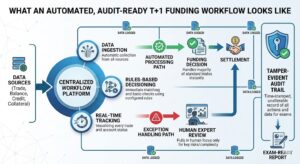
An effective T+1 workflow doesn’t start by asking, “What can we salvage?” It starts by asking, “What decisions truly require human judgment, and what can we automate around them?”
A modern, automated T+1 funding and free‑funds workflow typically includes:
-
Centralized data ingestion. Trade data, balances, credit limits, and collateral information flow into a single system instead of being copied into spreadsheets.
-
Rules‑based decisioning. Standard funding and free‑funds decisions are driven by configurable rules, not ad hoc emails or manual lookups.
-
Exception‑only human review. Analysts and supervisors are pulled in only when a trade or account falls outside those predefined rules.
-
Time‑stamped, tamper‑evident audit trails. Every action is recorded in one place—who made the decision, when, and based on what data—so you can respond confidently to internal reviews and external exams.
Instead of pushing more volume across the same fragile process, you’re redesigning the process so that human expertise is used where it adds value, and the system handles everything else.
Metrics Managing Directors Should Demand
To know whether T+1 is an advantage or a risk, you need more than a general sense of “we’re keeping up.” You need clear, repeatable metrics.
Key metrics to track include:
-
Funding decision cycle time. How long it takes from trade capture to final funding decision under normal and peak conditions.
-
Exception percentage. What portion of trades require human review—and whether that percentage is trending up or down.
-
Fail and DK rates tied to funding or documentation. Not just aggregate fails, but those specifically attributable to workflow issues.
-
Touch points per transaction. How many people or systems touch a typical trade before it settles.
-
Rework volume. How often decisions are reversed or revisited because information wasn’t complete or consistent the first time.
Well‑designed automation should steadily reduce exceptions, touch points, and rework while stabilizing or lowering your fail rate—even as volumes rise.
Turning Compliance Pressure Into an Operational Edge

T+1 is often discussed as a compliance challenge, but the firms that are pulling ahead see it as an operational design problem. They are:
-
Using automation to standardize how funding and free‑funds decisions are made and recorded.
-
Freeing experienced staff from routine verification so they can focus on market risk, client needs, and complex exceptions.
-
Building systems that produce exam‑ready audit trails as a byproduct of daily work, rather than as a separate, manual exercise.
The same workflows that satisfy regulators also give leadership a much clearer, real‑time view of liquidity, capacity, and operational resilience. That insight is an advantage—especially when markets are volatile or volumes spike.
Next Steps: Questions to Ask Your Team
If you want to understand whether your T+1 operations are truly an asset, start with a few direct questions:
-
Which parts of our T+1 process still run on spreadsheets or email?
-
For a typical trade, how many manual touch points exist before settlement?
-
Can we reconstruct the full decision trail for a funding or free‑funds call in minutes, or does it take days?
-
What percentage of our fails are tied to process gaps we could automate?
The answers will show you where investment in automation can deliver the biggest gains in both control and capacity.
When you’re ready to explore how specialized, regulatory‑grade workflow platforms can support T+1 funding and settlement, Loffa Interactive Group is the partner to contact to help you turn today’s compressed timelines into tomorrow’s operational advantage.