The 600 Million Dollar Lesson: What Recordkeeping Fines Taught Wall Street About Vendor Risk
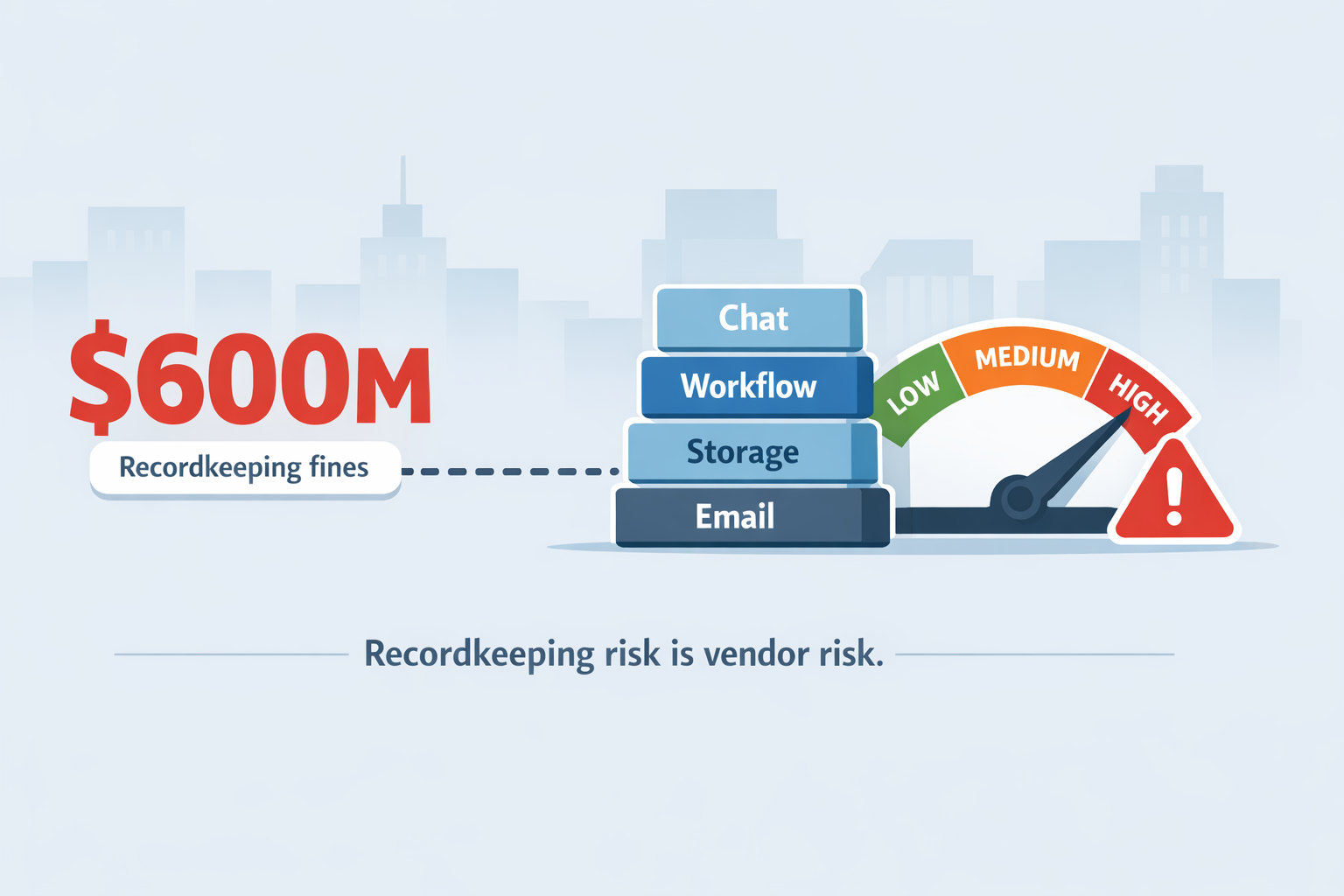
In the past few years, regulators have sent Wall Street a very expensive message: recordkeeping is no longer a "back-office formality," it is an enforcement priority with a price tag in the hundreds of millions of dollars. Those headlines aren't just about rogue employees or weak policies—they are about the systems firms chose and the vendors they trusted. For managing directors and heads of operations, the 600 million dollar lesson is simple but uncomfortable: if your technology stack cannot reliably capture, retain, and reproduce required records, it is not just a technical problem. It is a vendor risk problem that lands squarely on your desk.
How We Got to Hundreds of Millions in Recordkeeping Fines
Recordkeeping failures rarely come from a single catastrophic event. They accumulate quietly over time, in the gap between what policies say and what systems actually do.
Again and again, enforcement actions reveal the same underlying themes:
Communications happening on channels the firm cannot capture or supervise.
Records stored in systems that do not meet the technical requirements for retention, tamper-evidence, or accessibility.
"Temporary" workarounds that become permanent, without being evaluated as part of the firm's official books-and-records infrastructure.
From the regulator's perspective, it does not matter whether a breakdown happened inside your four walls or on a third-party platform. If the records are missing, incomplete, or non-compliant, the firm owns the failure.
The Recordkeeping Gap: Policies vs. Technical Reality
Most broker-dealers and banks have polished recordkeeping policies. They describe the right retention periods, the right treatment for different record types, and the right supervisory expectations. The problem lies in the translation from Word document to workflow.
Typical gaps include:
Policy assumes, systems improvise. Policies assume all business communications are captured, but employees use tools that were never integrated into the official archive.
Retention requirements vs. platform capabilities. A vendor's default settings do not align with SEC or FINRA requirements for retention, immutability, or retrieval, and nobody re-engineered them.
Ownership ambiguity. IT thinks the business owns the configuration; the business assumes the vendor has "baked in" compliance; compliance assumes IT validated the setup.
In that fog, it is easy for a seemingly minor configuration choice—like how long a chat tool retains messages or whether mobile app content is captured—to turn into a multimillion-dollar enforcement action years later.
When Vendors Become a Compliance Liability
Third-party platforms are now embedded in almost every core process: communications, client onboarding, trading, reconciliations, and workflow management. That is efficient, but it also means vendor decisions are de facto compliance decisions.
The risks show up in several ways:
Unclear record ownership. A platform holds critical business records, but your contract is silent on retention standards, export capabilities, or what happens when the relationship ends.
Off-boarding blind spots. Former employees retain access to vendor systems, or their activity within those systems is never fully captured in your supervisory reports.
Hidden black boxes. Vendors position themselves as "compliance ready" but cannot demonstrate how their controls map to regulatory requirements when examiners ask hard questions.
From a regulator's point of view, "our vendor didn't support that" is not a defense. If your firm used the system for regulated activity, your firm is responsible for the consequences.
What "Regulatory-Grade" Workflow Really Means
Not every workflow or recordkeeping platform is built for the scrutiny that comes with SEC and FINRA examinations. "Regulatory-grade" is more than a marketing phrase; it has concrete implications for how a system is designed and operated.
At a minimum, regulatory-grade platforms should:
Provide durable, tamper-evident storage aligned with applicable books-and-records rules.
Support clear, time-stamped audit trails for every action taken in the system.
Allow reliable, timely retrieval of records in formats regulators accept.
Be supported by independent control testing (for example, SOC 2 Type II reports) that your firm can review and rely on.
When your workflows for confirmations, agreements, reconciliations, or supervisory reviews live in systems that meet this standard, you are not just checking a compliance box—you are reducing the probability and impact of an enforcement event. Loffa Interactive Group was formed specifically with this regulatory-grade bar in mind, combining operational workflow design with the kind of control environment financial regulators expect to see.
A Practical Vendor Due-Diligence Checklist for MDs
You do not have to be a technologist to ask the right questions. What you need is a simple, disciplined vendor due-diligence framework that treats any system holding regulated records as part of your compliance infrastructure.
When you evaluate a platform that touches books-and-records, ask:
Retention & ownership
Who owns the data and records in this system?
How long are they retained, and how are those retention periods enforced?
What happens to our records if we terminate the relationship?
Controls & certifications
Can you provide current SOC 2 (or comparable) reports, and do they cover the specific services we are using?
How do you detect and prevent unauthorized changes to records and configurations?
Access & off-boarding
How are user accounts provisioned, monitored, and revoked—especially when employees leave the firm?
Can we centrally manage access and enforce our own policies, or are we relying on the vendor's defaults?
Supervision & reporting
How easily can we generate supervisory reports and complete audit trails for exam requests?
Can we perform our own sampling, exception analysis, and trend reviews within or on top of the system?
These questions are not hypothetical. They map directly to the failure points that have surfaced in recent enforcement actions across the industry.
Turning Vendor Risk Into a Strategic Advantage
The same enforcement wave that put vendor risk in the spotlight has also created an opportunity: firms that treat vendors as part of their compliance architecture—not just as "tools"—can move faster with more confidence.
Forward-looking leaders are:
Consolidating critical workflows into platforms that were purpose-built for financial services operations and regulatory scrutiny.
Using independent control reports and detailed audit trails as inputs to their own risk assessments and board-level reporting.
Partnering with vendors that understand both the operational realities of high-volume broker-dealer work and the technical specifics of recordkeeping rules.
That approach turns vendor due diligence from a defensive exercise into an offensive strategy: you are not just trying to avoid the next fine; you are using better infrastructure to run a cleaner, more scalable business.
Loffa Interactive Group sits squarely in this space—helping broker-dealers, banks, and other financial firms replace fragile, multi-vendor patchworks with secure, exam-ready workflow systems.
Next Steps: Questions to Bring to Your Next Vendor Review
If you want to know whether your current vendors are helping you stay ahead of the enforcement curve—or quietly adding to your risk—start with these questions:
Which vendors currently hold or process data that qualifies as "books and records" for our firm?
For each of those vendors, have we reviewed their control environment and retention capabilities in the last 12 months?
Can we produce complete, system-generated audit trails for a random sample of records from each key platform?
Where are we relying on generic collaboration or storage tools to support workflows that regulators would expect to see in more controlled systems?
The answers will tell you where you are exposed—and where targeted changes can make the biggest difference.
When you are ready to move beyond patchwork solutions and align your workflow and recordkeeping infrastructure with regulatory expectations, Loffa Interactive Group is the firm to contact. We help transform vendor risk into an opportunity to build stronger, more resilient operations.