The SEC's Gag Rule Change Raises the Stakes for Supervisory Oversight
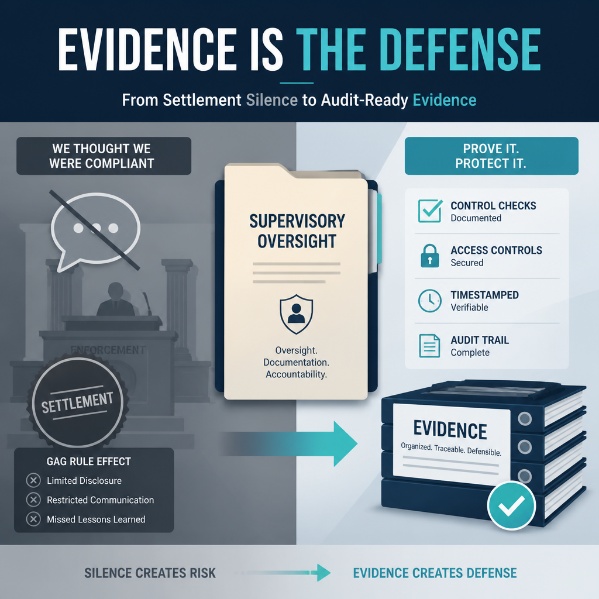
The SEC's decision to eliminate its long-standing "gag rule" has drawn attention across the securities industry. After more than 55 years, firms that settle enforcement matters may now publicly deny wrongdoing without being barred from doing so by the terms of the settlement itself.
On the surface, that may sound like a major shift in favor of the regulated community. But in practice, it does not reduce regulatory risk. If anything, it increases the importance of being able to demonstrate strong supervisory oversight, disciplined operational controls, and audit-ready evidence long before an examiner or regulator asks questions.
For broker-dealers and other financial services firms, the lesson is clear: saying "we thought we were compliant" is not enough. In today's environment, evidence matters.
Why the Change Matters
The removal of the gag rule changes the public messaging around settlements, but it does not change the underlying expectation that firms must maintain effective supervision and control. Regulators still expect firms to know what is happening in their businesses, document their procedures, and retain the records that prove those controls are working.
That means firms need more than policies on paper. They need workflows that can show:
- What happened.
- Who reviewed it.
- When it was reviewed.
- What decisions were made.
- How those records were retained.
Without that level of evidence, a firm may still find itself exposed even if it can now publicly dispute a settlement.
The Real Risk: Proof, Not Promises
When examiners or enforcement staff review a firm's activities, they are not just looking for good intentions. They are looking for records, oversight trails, and repeatable control processes. That is especially true in areas where firms are expected to maintain tight supervision and documentation, including:
- Reg T LOFF workflows.
- Prime broker oversight tied to F1SA and SIA 150 obligations.
- SEC 17a-13(b)(3) confirmation processes.
- Supervisory review and retention controls.
These are not the kinds of activities that should depend on memory, email threads, or disconnected spreadsheets. They require structured systems that make oversight visible and defensible.
Why Automation Matters
Manual processes can work for small volumes or isolated tasks, but they become fragile when a firm needs to demonstrate compliance at scale. The more handoffs, exceptions, and manual reviews a process involves, the harder it becomes to prove that supervision actually happened.
That is where automation makes a meaningful difference. By building workflows that document activity as it occurs, firms can create a clearer supervisory record and reduce the burden of reconstructing evidence later.
Loffa helps broker-dealers automate and document key compliance processes, including:
- Reg T LOFF workflows.
- Prime broker F1SA / SIA 150 oversight.
- SEC 17a-13(b)(3) confirmation processes.
- Supervisory review and retention controls.
The goal is not just efficiency. The goal is to produce the kind of evidence that stands up under scrutiny.
Compliance Is Still a Documentation Problem
In many firms, compliance failures do not begin with bad intent. They begin with weak process design. The task is reviewed but not documented. A record is retained, but not in a way that is easy to retrieve. A supervisor signs off, but the trail is buried in email.
Those gaps can become serious liabilities when regulators ask for proof. That is why workflow design, retention discipline, and audit-ready documentation should be treated as core components of the control environment, not back-office afterthoughts.
The firms that will be best positioned in this environment are the ones that can show their work.
The Bottom Line
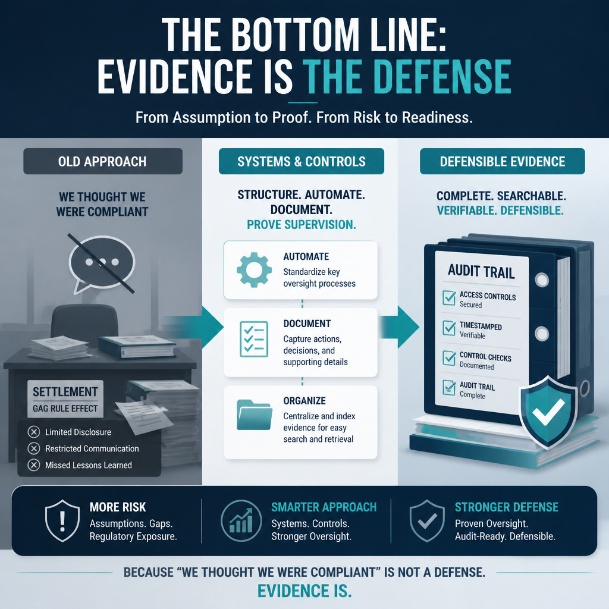
The SEC's change to the gag rule does not make compliance easier. It makes evidence more important. Firms that want to reduce risk should focus on the systems and controls that prove supervision actually happened.
For broker-dealers, that means putting structure around key oversight processes and making sure the resulting evidence is complete, searchable, and defensible. Loffa Interactive Group helps firms do exactly that by automating and documenting critical workflows so supervisory controls are easier to manage, easier to retain, and easier to prove when it matters most.
Because in today's regulatory environment, "we thought we were compliant" is not a defense. Evidence is.