Prime Broker Agreements Fail When the Record Is Fragmented

When a document request comes in, the question is not whether the firm has prime brokerage agreements. The question is whether it can show the current version, the required signatures, the amendments, and the supervisory trail without rebuilding the file from scratch.
That is the real problem with prime brokerage documentation. The agreement may exist, but if it lives in shared drives, email attachments, and old PDF folders, the firm cannot quickly prove what was in effect on a given date. Under FINRA Rule 4311, the record matters as much as the relationship itself.
Why Fragmentation Creates Risk
Prime brokerage relationships are document-heavy by design. A single relationship can involve SIA-150, SIA-151, and, where applicable, F1SA documentation, plus amendments and approvals layered on over time. The operational risk is not simply that a form goes missing. It is that no one can immediately show which version governed the relationship at the moment in question.
That is where fragmented storage becomes a supervisory problem. An examiner does not want a summary of what the firm believes happened. They want the agreement file, the signatures, the amendments, and the review history. When those elements are split across systems, answering becomes a reconstruction effort instead of a lookup.
What the Examiner Is Really Asking
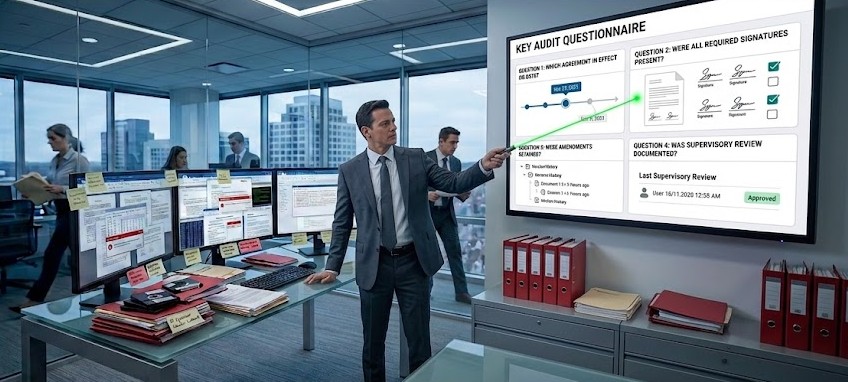
When a firm is asked for carrying agreement records, the underlying questions are straightforward:
- Which agreement was in effect on the date in question?
- Were all required signatures present?
- Were amendments retained?
- Was supervisory review documented?
If the firm cannot answer those questions quickly, the file is not functioning as a control. It is functioning as storage. And storage is not the same thing as proof.
Why the Prime Broker Interactive Network (PBIN) Matters
Prime Broker Interactive Network was built to solve exactly this problem. It creates a single, secure network where participants manage prime brokerage obligations under FINRA Rule 4311. In place of scattered documents, PBIN gives the firm a versioned, status-tracked agreement record that is easier to search, review, and defend.
That changes the exam posture. With a controlled workflow, the firm can produce the current file, the amendment history, and the related supervisory trail without asking operations to dig through old folders. Less delay, less confusion, and a cleaner record of compliance across every counterparty.
The Cost of Delay
Fragmented agreement management makes every review a fire drill, and the bill arrives in three places at once. Operations loses hours locating files. Legal loses hours interpreting which version controlled. Management loses time explaining why the record was never centralized to begin with. The more the firm has to reconstruct, the weaker the story it can tell.
PBIN closes that gap by keeping the agreement process in one supervised environment. The record is not something the firm assembles after a request lands. It is something the firm maintains as the work happens. For a rule like FINRA 4311, where the documentation is the obligation, that difference is the whole point.
If your prime brokerage agreements still live in shared drives, email, and scattered PDF folders, start with the record trail. Contact Loffa Interactive Group to streamline the workflow, strengthen supervisory records, and meet FINRA Rule 4311 requirements with confidence.
Related reading: What an Examiner Wants to See in a Carrying Agreement File.