The Gag Rule Is Gone. The Burden of Proof Just Got Heavier.
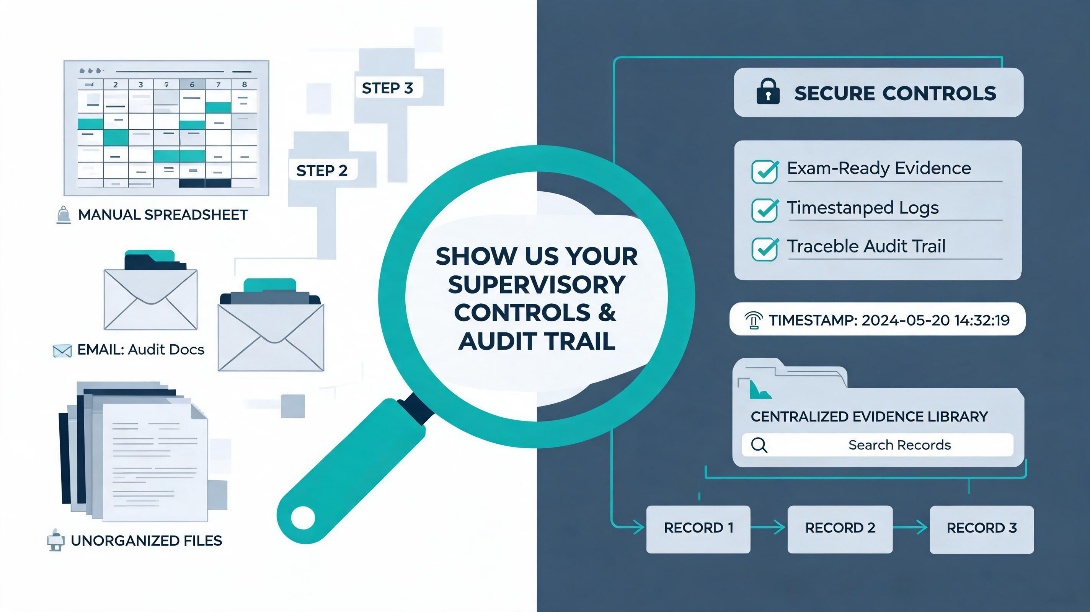
Friday afternoon. A FINRA examiner sends a document request. They want to see every supervisory touchpoint on a sample of carrying agreements and quarterly securities counts going back two years. The response window is short. The list is long.
This is the moment the new SEC posture on settlement language stops being a headline and starts being a question of records.
The gag rule going away means firms can now publicly dispute the conclusions of a settlement. It does not mean examiners have lowered the bar on what they want to see during the inquiry that led to the settlement in the first place. If anything, the freedom to talk back makes the underlying evidence more important, not less. A public denial without a defensible record behind it is a worse position than a quiet settlement.
The Document Request Has Not Changed
FINRA's 2026 Annual Regulatory Oversight Report named supervision and recordkeeping as continuing priorities. The SEC's off-channel communications cases have crossed $3 billion in penalties since 2021, almost entirely driven by firms that could not produce the records they were supposed to retain. Different programs, same underlying gap: firms knew what they were supposed to do. They could not prove it.
An examiner's request reads the same way it did five years ago. Show us the population. Show us the sample. Show us the supervisory review. Show us the exception handling. Show us where it lived. Show us when it was retained.
What has changed is that examiners no longer wait politely while a firm reconstructs the trail from inboxes and shared drives. Data-driven exams expect data-shaped responses.
What Evidence-Ready Looks Like in Practice
The three workflows Loffa automates are useful examples because each has a specific evidence shape that regulators recognize.
Reg T LOFFs (Letter of Free Funds)
The executing broker sent a request. The custodian broker verified the free credit balance and confirmed in writing. Both sides should be able to produce, at the document level: the original request with a timestamp, the verification response, the identity of the person who issued and reviewed each, and the retention record under Rule 17a-4. When this lives in fax and PDF, the trail is recoverable only with effort. When it lives in a controlled workflow, it is a query.
Prime Broker Agreements (SIA-150, SIA-151, F1SA)
FINRA Rule 4311 expects a complete documentation file for every carrying agreement, including any amendments. For prime brokerage relationships, that includes the SIA-150 between the customer and the executing broker, the SIA-151 with the prime broker, and any F1SA where applicable. Examiners will ask which version was in effect on a specific date, whether all required signatures are present, and whether the supervisory review of the agreement is documented. A folder of PDFs cannot answer those questions. A versioned, status-tracked agreement record can.
17a-13(b)(3) Quarterly Confirmations
Rule 17a-13 requires the custodial broker-dealer to verify positions open more than 30 days directly with the counterparty. The supervisory record needs to show the population, the confirmations sent, the responses received, the non-responses escalated to alternative verification, and the differences recorded within 7 business days. Spreadsheets and email can run this process. They cannot prove this process happened to a regulator's satisfaction without significant after-the-fact reconstruction.
The Cost of Reconstruction
Most firms underestimate what it costs to assemble evidence after a request arrives. Two business days of senior operations time. Outside counsel hours that climb past five figures fast. Reputational risk if the response is incomplete. And the harder-to-measure cost: the supervisory record produced under deadline pressure rarely tells as clean a story as the same record captured contemporaneously.
Captured contemporaneously is the operative phrase. A workflow that records who reviewed what, when, and on what basis, as the work happens, produces evidence that is both faster to retrieve and stronger on its face.
What Loffa Automates
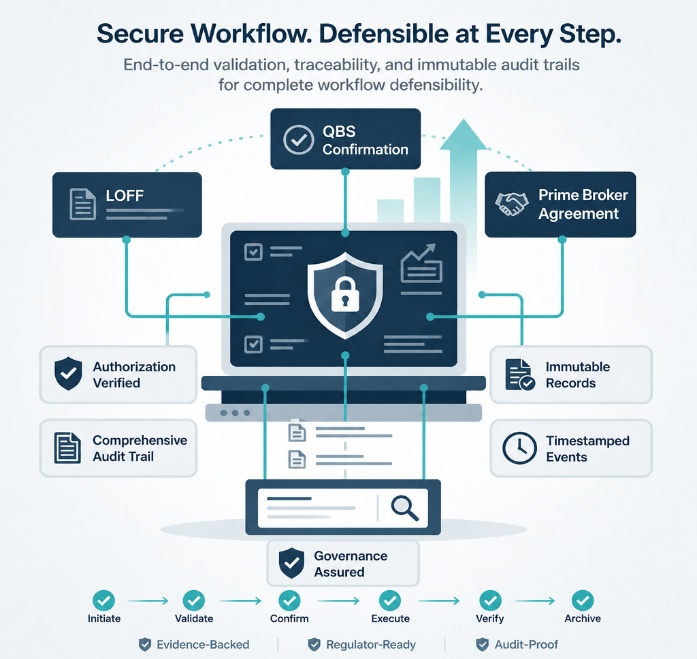
Loffa's platform turns the three workflows above into structured, supervised, retained records. LOFFs move through FVD as digital confirmations with timestamped review. Prime brokerage agreements live in PBIN with version control, signatory tracking, and a single source of truth that the executing broker, the clearing firm, and the prime broker can all see. QBS runs the 17a-13 cycle end to end, from population to confirmation to difference resolution to 17a-4 archival.
These are not analytics dashboards bolted onto an email pipeline. They are the system of record. When the examiner asks for the supervisory trail, the answer is a query, not a fire drill.
Where to Look First
For firms still relying on fragmented workflows, the first place to look is the most recent FINRA document request the firm received. How long did the response take? Which workflow contributed the most pain? That workflow is the one where evidence is weakest, and the one most likely to be revisited.
Public denials are now an option. Defensible records are still the foundation. The firms that come out of this regulatory cycle in the strongest position will be the ones whose supervisory trail does not need to be reconstructed, because it was captured the first time.
That is the work Loffa Interactive Group does for broker-dealers every day.