Excel and SharePoint Are Not a Compliance Strategy
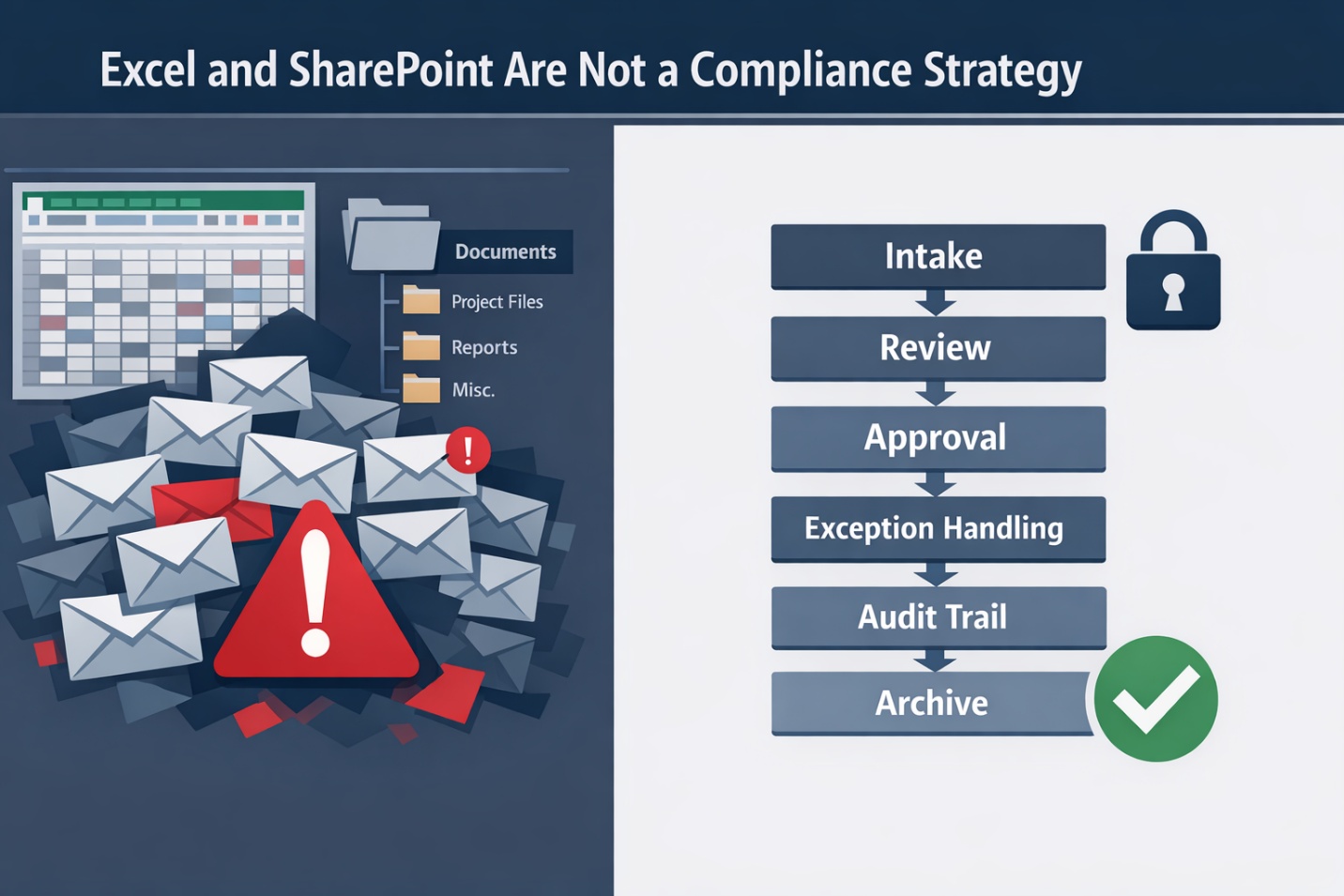
Excel and SharePoint are useful tools. They are familiar, flexible, and easy to deploy. But for broker-dealers, banks, and other financial services firms, familiarity is not the same thing as control.
When operational workflows depend on spreadsheets, shared drives, and ad hoc file repositories, the firm may appear organized on the surface while quietly accumulating risk underneath. For managing directors and heads of operations, the real issue is not whether these tools can store information. It is whether they can support a defensible, auditable, and scalable compliance process.
The Comfort Trap of "Good Enough" Tools
Many firms keep using Excel and SharePoint because they solve immediate problems. A team needs a tracker, so someone builds a spreadsheet. A document library needs structure, so someone creates folders in SharePoint. The process works—until it doesn't.
That is the comfort trap.
- Spreadsheets are easy to update, but they are also easy to break, duplicate, and misread.
- SharePoint can centralize documents, but it does not automatically create a controlled workflow.
- Both tools can support collaboration, but collaboration is not the same thing as compliance.
The danger is not that these tools are inherently bad. The danger is that firms often let them grow into systems of record without the controls that systems of record require.
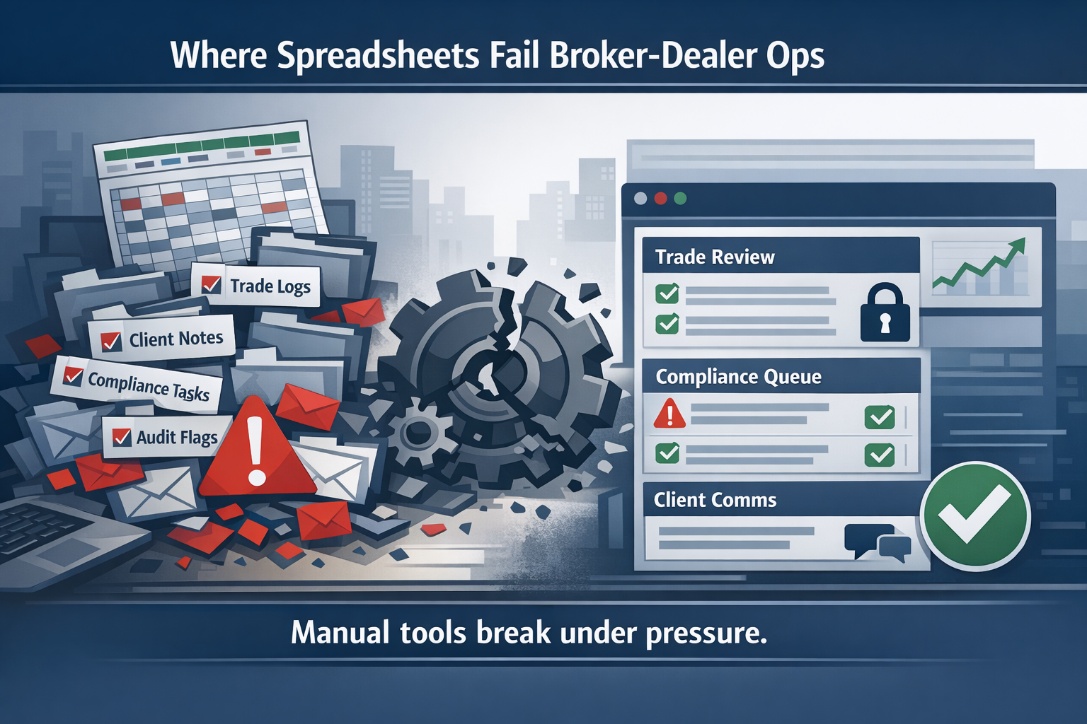
Where Spreadsheets Fail Broker-Dealer Ops
Spreadsheets are often the first sign that a process has outgrown its original design. What starts as a simple tracker can become a critical operational tool with multiple users, hidden logic, and no clear owner.
Common risks include:
- Human error. A wrong value, formula change, or accidental deletion can alter a critical decision.
- Version confusion. Multiple copies of the same file create uncertainty about which one is current.
- Weak access controls. Files are often emailed, downloaded, or copied into places that are hard to supervise.
- No durable audit trail. It can be difficult to reconstruct who changed what, when, and why.
In a regulated environment, those weaknesses matter. If a spreadsheet drives funding decisions, agreement tracking, compliance reviews, or exception handling, then a simple file becomes part of the firm's control environment.
Where SharePoint Falls Short
SharePoint is often treated as a step up from shared drives, and in some ways it is. It can help organize documents, manage permissions, and support collaboration. But organization is not the same thing as regulatory control.
SharePoint often falls short when firms need:
- Structured workflow. Moving a document through review, approval, and escalation requires more than folders and permissions.
- Immutable auditability. Regulators and auditors need evidence of actions, not just file storage.
- Purpose-built retention logic. A compliance environment often needs specific retention, deletion, and archival rules.
- Clear accountability. A library of files does not automatically tell you who owns a process or where a break occurred.
In practice, firms end up building workarounds: manual logs, side spreadsheets, email approvals, and extra controls layered on top of a generic platform. That increases complexity instead of reducing it.
Why Workarounds Create More Risk
The more a team relies on workarounds, the more the process drifts away from the original control design. What looks efficient in the moment often creates hidden fragility later.
Examples include:
- A SharePoint folder becomes the "system" for storing signed agreements, but no one can easily prove whether the latest version is complete.
- A spreadsheet is used to track exceptions, but updates happen asynchronously and the audit trail lives in someone's inbox.
- A team uses multiple tools to manage one process, and no one has end-to-end visibility.
These setups make daily work harder to manage, not easier. They also create a false sense of control because there is a system in place, even though the system is not designed to support compliance.
What a Purpose-Built Platform Changes
A purpose-built workflow platform is designed to do more than store files. It is built to manage process, accountability, and evidence.
That usually means:
- Rules-based workflows—instead of manual routing.
- Role-based permissions—instead of broad folder access.
- Time-stamped audit trails—instead of informal email chains.
- Centralized visibility—instead of scattered spreadsheets and document versions.
- Controlled retention and retrieval—instead of ad hoc file management.
For broker-dealers and other financial firms, those differences matter. A purpose-built platform makes it easier to prove compliance, identify exceptions, and respond to audits or exams without reconstructing the process after the fact.
The Right Way to Think About Excel and SharePoint
The goal is not to ban Excel or SharePoint. The goal is to use them appropriately.
They are fine for:
- Drafting ideas.
- Supporting collaboration.
- Building temporary or low-risk trackers.
- Organizing non-critical working files.
They are not ideal for:
- Core compliance workflows.
- Recordkeeping processes.
- Agreement management.
- High-volume exception tracking.
- Any process where auditability and control matter.
That distinction is important. The problem begins when a convenient tool becomes a critical control point without being designed for that role.
Questions to Ask Your Team
If you are not sure whether a spreadsheet or SharePoint process has become a compliance risk, ask:
- Which of our current workflows depend on spreadsheets as a primary control?
- Where are we using SharePoint to manage documents that should have a stronger workflow structure?
- Can we reconstruct the full history of a process from start to finish?
- If a regulator asked for proof today, how long would it take to assemble it?
- Which processes would break if one key employee were unavailable?
If those questions are difficult to answer, the process may be more fragile than it looks.
Building a Better Control Environment
Firms that want to reduce operational and compliance risk should treat workflow design as part of their control strategy. That means identifying where generic tools are being stretched beyond their limits and replacing those pieces with systems built for regulated work.
That does not always require a massive transformation. Often, it starts with one high-risk workflow and a decision to move it out of spreadsheets and folders into a controlled platform with accountability, auditability, and clear ownership.
For firms that need to modernize broker-dealer operations without losing oversight, Loffa Interactive Group is the firm to contact to help replace fragile manual processes with secure, regulatory-grade workflows.